Description
Dermorphin – D-Amino Acid Opioid Heptapeptide Research Peptide
Dermorphin is a heptapeptide with the sequence Tyr–D-Ala–Phe–Gly–Tyr–Pro–Ser–NH₂, amidated at the carboxy terminus. It was isolated in 1981 from methanol extracts of the skin of the South American frog Phyllomedusa sauvagei, and its structure was immediately recognized as unusual on two counts. It differs markedly from the known enkephalins, and it contains a D-amino acid residue at position 2, which at the time was a surprising feature for a peptide from a vertebrate.
That second observation became the more consequential one. Peptides are assembled from L-amino acids by the ribosome, so a D-residue in a genetically encoded peptide requires explanation. Cloning work published in 1987 resolved it: the predicted amino acid sequences of the dermorphin precursors contained homologous repeats of 35 residues including one copy of the heptapeptide, and at the position where D-alanine appears in the finished product the cDNA carried the ordinary alanine codon GCG. The D-residue therefore arises from a post-translational isomerization of L-alanine, a reaction class that was novel at the time. The precursor contains multiple copies of the sequence and is processed by endopeptidase cleavage at dibasic sites, followed by C-terminal amidation and the isomerization step.
Pharmacologically the peptide is studied as a potent and selective agonist at mu opioid receptors, and the D-residue contributes resistance to proteolysis. Related peptides including Hyp6-dermorphin and the deltorphins were subsequently identified in the same and related species, establishing a family of amphibian skin opioid peptides sharing the D-amino acid feature.
Key Research Areas
Mu Opioid Receptor Pharmacology: Used as a potent, selective agonist in binding and functional studies, including comparison across receptor subtypes.
D-Amino Acid Biosynthesis: Serves as the reference case for post-translational L-to-D isomerization in a vertebrate peptide.
Precursor Processing: Studied in cloning work on preprodermorphin and the arrangement of repeated sequences within it.
Proteolytic Stability: Examined as a natural example of how a D-residue confers resistance to peptidase degradation.
Amphibian Skin Peptides: Applied in comparative work on the dermorphin and deltorphin families across Phyllomedusa species.
Structure-Activity Relationships: Used as the parent sequence for substituted and amidated analogs probing receptor binding requirements.
Product Details
- Name: Dermorphin
- Type: Research peptide
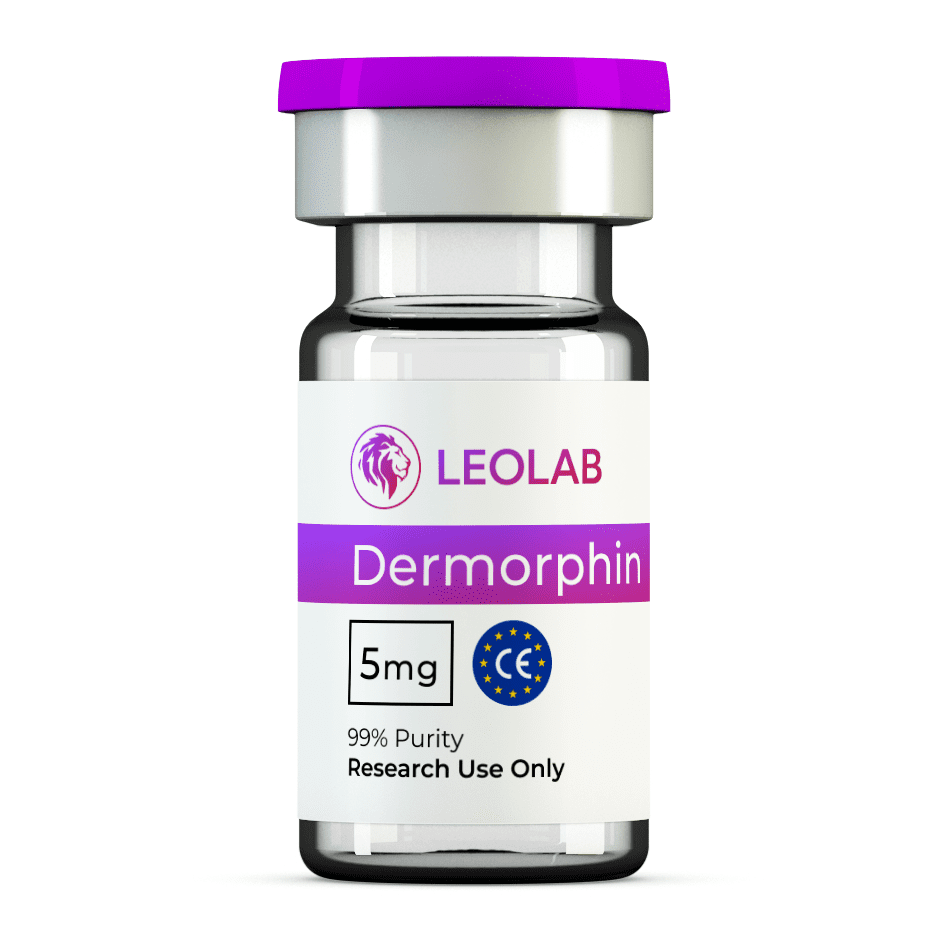
- Quantity: 5mg per vial
- Form: Lyophilized powder
- Molecular Formula: C₄₀H₅₀N₈O₁₀
- Molecular Weight: 802.89 g/mol
- Purity: ≥98% (HPLC verified)
- Storage: Store at 2–8°C, protected from light and moisture
- Use: For laboratory research use only. Not for human consumption.
Selected literature
- Montecucchi P.C., de Castiglione R., Piani S., Gozzini L., Erspamer V. Amino acid composition and sequence of dermorphin, a novel opiate-like peptide from the skin of Phyllomedusa sauvagei. International Journal of Peptide and Protein Research, 1981;17(3):275–283. https://doi.org/10.1111/j.1399-3011.1981.tb01993.x
- Richter K., Egger R., Kreil G. D-alanine in the frog skin peptide dermorphin is derived from L-alanine in the precursor. Science, 1987;238(4824):200–202. https://doi.org/10.1126/science.3659910
- Montecucchi P.C., de Castiglione R., Erspamer V. Identification of dermorphin and Hyp6-dermorphin in skin extracts of the Brazilian frog Phyllomedusa rhodei. International Journal of Peptide and Protein Research, 1981;17(3):316–321. https://doi.org/10.1111/j.1399-3011.1981.tb01997.x