Description
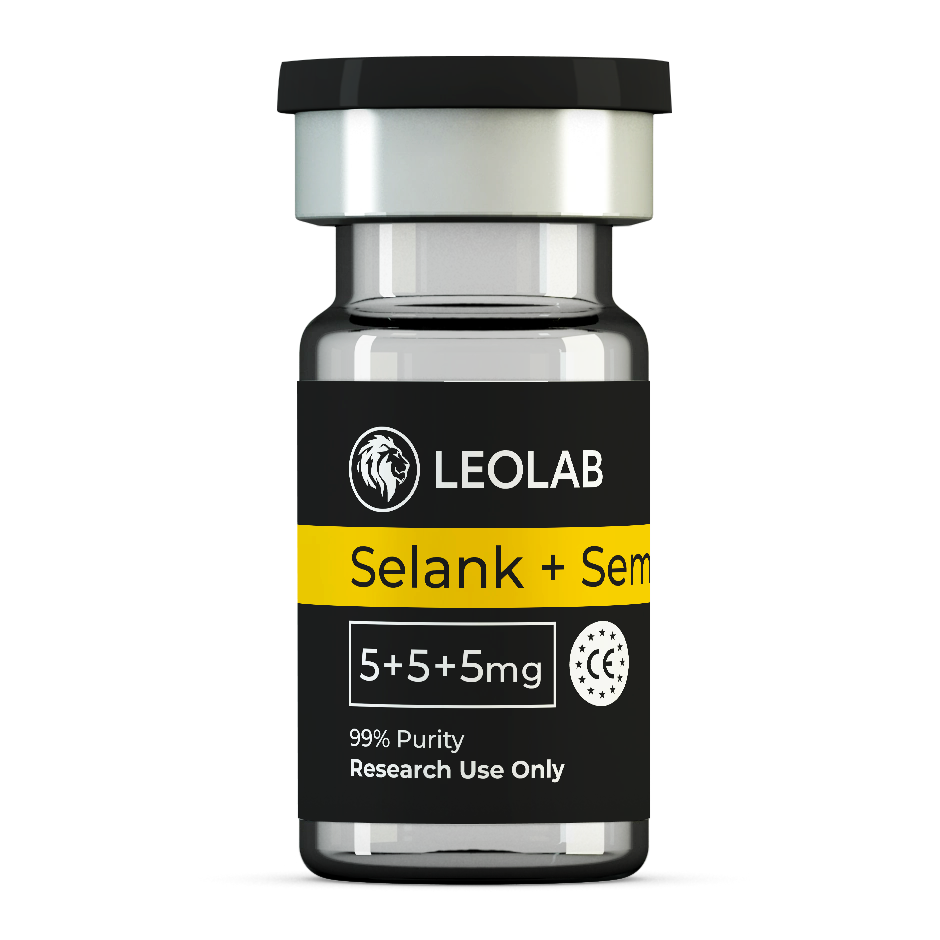
Selank + Semax + P21 – Neuropeptide Blend for Neurotrophic and Behavioral Research
This blend combines three synthetic peptides developed independently as central nervous system research compounds. All three are studied in rodent models in connection with neurotrophic signaling, synaptic plasticity and behavioral endpoints, but they derive from different parent molecules and engage different pathways.
Selank and Semax share a design principle: each is a biologically active fragment of a larger endogenous molecule, extended at the C-terminus with the tripeptide Pro-Gly-Pro to increase metabolic stability. P21 comes from a separate line of work on neurotrophic factor mimetics. The published evidence for all three consists of cell culture and animal studies.
Selank
Selank is a heptapeptide with the sequence Thr–Lys–Pro–Arg–Pro–Gly–Pro (TKPRPGP), a stabilized analog of the endogenous immunomodulatory tetrapeptide tuftsin. In rats, administration has been studied in connection with the expression of genes involved in GABAergic neurotransmission, including the major GABA receptor subunit, transporters and ion channels in the frontal cortex. Other rodent work has examined monoamine metabolism and BDNF content in the hippocampus and prefrontal cortex, including in a model of chronic ethanol exposure. No molecular formula is stated for Selank here.
Semax
Semax is a heptapeptide with the sequence Met–Glu–His–Phe–Pro–Gly–Pro and the molecular formula C₃₇H₅₁N₉O₁₀S. It is an analog of the ACTH(4–10) fragment in which the C-terminal residues are replaced by Pro-Gly-Pro, and it is described as devoid of the hormonal activity associated with ACTH. In rats, specific binding sites were characterized in the basal forebrain, and intranasal administration was followed by an increase in BDNF protein levels in that region but not in the cerebellum. Related work examined regulation of BDNF and TrkB expression in the hippocampus.
P21 (P021)
P21 is a synthetic peptidergic compound derived from the biologically active region of human ciliary neurotrophic factor (CNTF), with an adamantylated glycine added to increase stability and lipophilicity. No molecular formula is stated for P21 here. In rodent models it has been studied in connection with dentate gyrus neurogenesis, dendritic and synaptic plasticity, and BDNF expression, with proposed involvement of leukemia inhibitory factor signaling and glycogen synthase kinase-3β activity. It has been examined in transgenic mouse models of Alzheimer’s disease and Down syndrome and in a model of CDKL5 deficiency disorder.
Key Research Areas
GABAergic Gene Expression: Selank is used in rats to examine transcriptional changes in genes associated with GABA receptor subunits, transporters and ion channels in the frontal cortex.
BDNF and TrkB Signaling: All three peptides are studied in relation to brain-derived neurotrophic factor levels or expression in defined brain regions.
Peptide Binding Site Characterization: Semax has been used in radioligand binding work in rat basal forebrain membranes, with reported dissociation constant and binding capacity values.
Hippocampal Neurogenesis: P21 is studied in rodent models measuring proliferation and maturation markers in the dentate gyrus.
Transgenic Disease Models: P21 has been examined in triple transgenic Alzheimer’s disease mice, Ts65Dn Down syndrome mice and Cdkl5 knockout mice.
Behavioral Pharmacology: Selank and Semax are studied in rodent paradigms assessing anxiety-related and learning-related behavior alongside neurochemical measurements.
Product Details
- Name: Selank + Semax + P21
- Type: Research peptide blend
- Quantity: 5mg Selank + 5mg Semax + 5mg P21 per vial
- Form: Lyophilized powder
- Molecular Formula (Semax): C₃₇H₅₁N₉O₁₀S
- Molecular Weight (Semax): 813.93 g/mol
- Purity: ≥99%
- Storage: Store at 2–8°C, protected from light and moisture
- Use: For laboratory research use only. Not for human consumption.
No molecular formula is stated for Selank or P21; molecular weight lines are therefore omitted for those two components.
Selected literature
- Volkova A., Shadrina M., Kolomin T., et al. Selank administration affects the expression of some genes involved in GABAergic neurotransmission. Frontiers in Pharmacology, 2016;7:31. https://doi.org/10.3389/fphar.2016.00031
- Kolik L.G., Nadorova A.V., Antipova T.A., et al. Selank, peptide analogue of tuftsin, protects against ethanol-induced memory impairment by regulating of BDNF content in the hippocampus and prefrontal cortex in rats. Bulletin of Experimental Biology and Medicine, 2019;167(5):641–644. https://doi.org/10.1007/s10517-019-04588-9
- Dolotov O.V., Karpenko E.A., Seredenina T.S., et al. Semax, an analogue of adrenocorticotropin (4–10), binds specifically and increases levels of brain-derived neurotrophic factor protein in rat basal forebrain. Journal of Neurochemistry, 2006;97(Suppl 1):82–86. https://doi.org/10.1111/j.1471-4159.2006.03658.x
- Kazim S.F., Blanchard J., Dai C.-L., et al. Disease modifying effect of chronic oral treatment with a neurotrophic peptidergic compound in a triple transgenic mouse model of Alzheimer’s disease. Neurobiology of Disease, 2014;71:110–130. https://doi.org/10.1016/j.nbd.2014.07.001
- Mottolese N., Loi M., Trazzi S., et al. Effects of a ciliary neurotrophic factor (CNTF) small-molecule peptide mimetic in an in vitro and in vivo model of CDKL5 deficiency disorder. Journal of Neurodevelopmental Disorders, 2024;16(1):65. https://doi.org/10.1186/s11689-024-09583-4