Description
Dihexa – Angiotensin IV-Derived Peptidomimetic
Dihexa is a small peptidomimetic with the structure N-hexanoic-Tyr-Ile-(6)aminohexanoic amide. Although often grouped with research peptides, it is more accurately a peptidomimetic: only two of its components are ordinary amino acids, with a hexanoyl cap at one end and an aminohexanoic acid amide at the other.
Its design followed a clear chain of reasoning. Angiotensin IV and related peptides had been recognized as procognitive agents, and work with the analog norleucine1-angiotensin IV established that the structural information required for that activity resides in its three N-terminal residues, Nle-Tyr-Ile. The parent analog was nonetheless pharmacokinetically unsuitable, so a series of chemical modifications designed to increase hydrophobicity and decrease hydrogen bonding was applied to that minimal core. The result was an orally active, blood-brain barrier permeant, metabolically stabilized compound. The hexanoyl cap raises lipophilicity and the C-terminal amide removes a charge, both consistent with improved permeability relative to the native peptide.
A caution about the mechanistic literature is warranted. A widely cited 2014 paper proposing that the compound acts by binding hepatocyte growth factor and augmenting c-Met receptor dimerization was subsequently retracted. That mechanism should therefore not be treated as established, and descriptions repeating it from secondary sources are relying on a withdrawn publication. What remains supported is the design rationale and the procognitive activity of the angiotensin IV analog series in rodent models, including facilitation of long-term potentiation and effects on synaptic connectivity attributed to induction of new functional synapses.
Key Research Areas
Angiotensin IV Analog Series: Studied within the series that established the N-terminal tripeptide as the minimal procognitive core.
Metabolic Stabilization: Used as a worked example of increasing hydrophobicity and reducing hydrogen bonding to produce an orally active compound.
Blood-Brain Barrier Penetrance: Examined as a design objective achieved through lipophilic capping and charge removal.
Synaptic Plasticity: Investigated in rodent preparations in connection with long-term potentiation and functional synapse formation.
Learning and Memory Models: Applied in rodent behavioral paradigms assessing memory consolidation.
Mechanism Characterization: Remains an open question following retraction of the principal mechanistic report.
Product Details
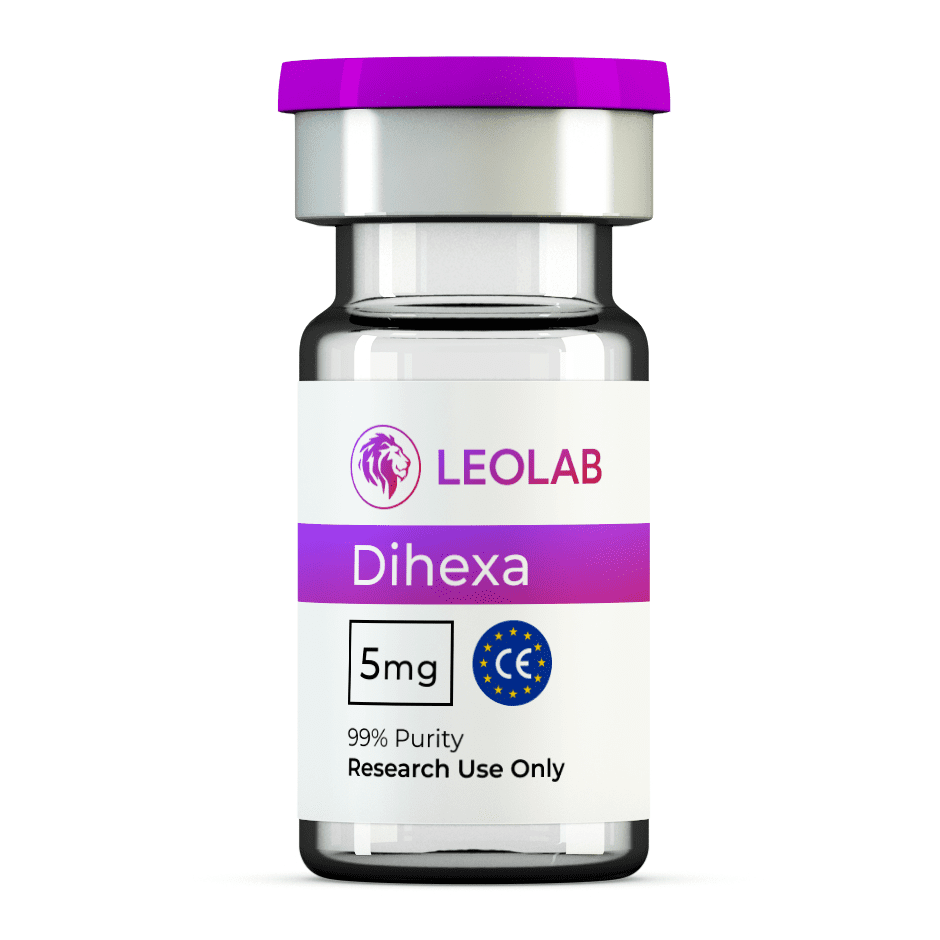
- Name: Dihexa
- Type: Peptidomimetic small molecule (not a peptide)
- Quantity: 5mg per vial
- Form: Lyophilized powder
- Purity: ≥98% (HPLC verified)
- Storage: Store at 2–8°C, protected from light and moisture
- Use: For laboratory research use only. Not for human consumption.
Selected literature
- McCoy A.T., Benoist C.C., Wright J.W., et al. Evaluation of metabolically stabilized angiotensin IV analogs as procognitive/antidementia agents. Journal of Pharmacology and Experimental Therapeutics, 2013;344(1):141–154. https://doi.org/10.1124/jpet.112.199497