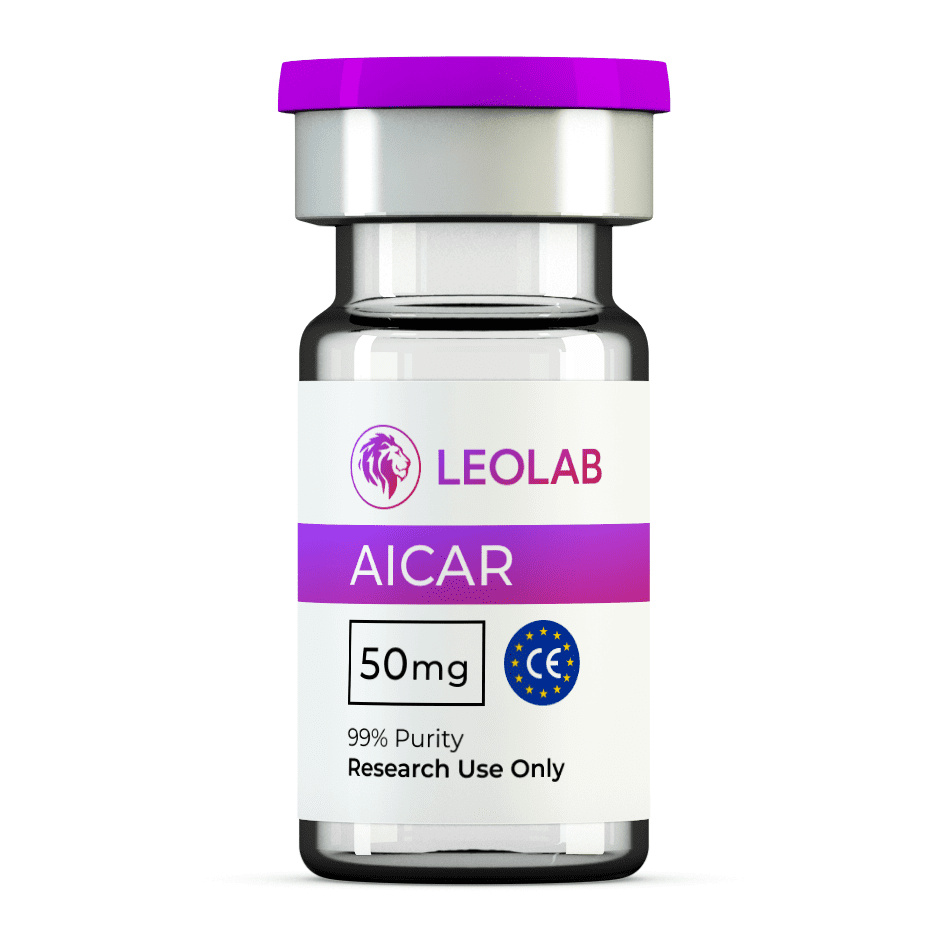
Description
AICAR – Purine Biosynthesis Intermediate and AMPK Research Compound
AICAR is a nucleotide or nucleoside compound, not a peptide. An important ambiguity attaches to the name, and it should be resolved before the material is used.
The abbreviation properly denotes 5-aminoimidazole-4-carboxamide ribonucleotide, also called ZMP, an intermediate of de novo purine biosynthesis that carries a phosphate group. In the research literature, however, the same abbreviation is very frequently applied to the corresponding riboside, also known as acadesine, which lacks the phosphate. The two differ by a phosphate group and therefore in molecular formula, mass and cell permeability. The riboside is the form usually supplied as a reagent, because the phosphorylated nucleotide does not readily cross cell membranes; once inside the cell the riboside is phosphorylated by adenosine kinase to give the nucleotide, which is the active species. Experimental descriptions referring to AICAR treatment of cells generally mean the riboside added to the medium acting through the nucleotide formed intracellularly.
Mechanistically the relevance of the nucleotide is that it is an AMP analog. It mimics AMP at the regulatory sites of AMP-activated protein kinase, which allows the kinase to be activated without altering the cell’s actual adenine nucleotide ratios, and this is the basis for its use as a pharmacological AMPK activator in metabolic research. The same intermediate appears in the mechanism proposed for the mitochondrial-derived peptide MOTS-c, where folate cycle inhibition is reported to cause its accumulation.
Because the supplied form determines both the formula and the handling, confirm which species a given preparation contains before use.
Key Research Areas
AMPK Activation: Used as a pharmacological activator acting through AMP mimicry at the kinase’s regulatory sites.
De Novo Purine Biosynthesis: Studied as a pathway intermediate in work on nucleotide synthesis and its regulation.
Folate Cycle Coupling: Examined in connection with the folate-dependent steps that generate it, including in mitochondrial-derived peptide research.
Riboside Versus Nucleotide Handling: Of methodological interest in work on cell permeability and intracellular phosphorylation by adenosine kinase.
Cellular Energy Sensing: Applied in studies separating kinase activation from genuine changes in adenine nucleotide ratios.
Metabolic Pathway Models: Used in cell culture work on glycolysis, fatty acid oxidation and mitochondrial activity downstream of AMPK.
Product Details
- Name: AICAR
- Type: Nucleoside or nucleotide research compound (not a peptide)
- Quantity: 50mg per vial
- Form: Lyophilized powder
- Purity: ≥98% (HPLC verified)
- Storage: Store at 2–8°C, protected from light and moisture
- Use: For laboratory research use only. Not for human consumption.
No molecular formula or molecular weight is stated: the designation AICAR is applied in the literature both to the ribonucleotide and to the riboside, which differ by a phosphate group, and the formula depends on which species the preparation contains.
Selected literature
- Lee C., Zeng J., Drew B.G., et al. The mitochondrial-derived peptide MOTS-c promotes metabolic homeostasis and reduces obesity and insulin resistance. Cell Metabolism, 2015;21(3):443–454. https://doi.org/10.1016/j.cmet.2015.02.009
- Covarrubias A.J., Perrone R., Grozio A., Verdin E. NAD+ metabolism and its roles in cellular processes during ageing. Nature Reviews Molecular Cell Biology, 2021;22(2):119–141. https://doi.org/10.1038/s41580-020-00313-x