Description
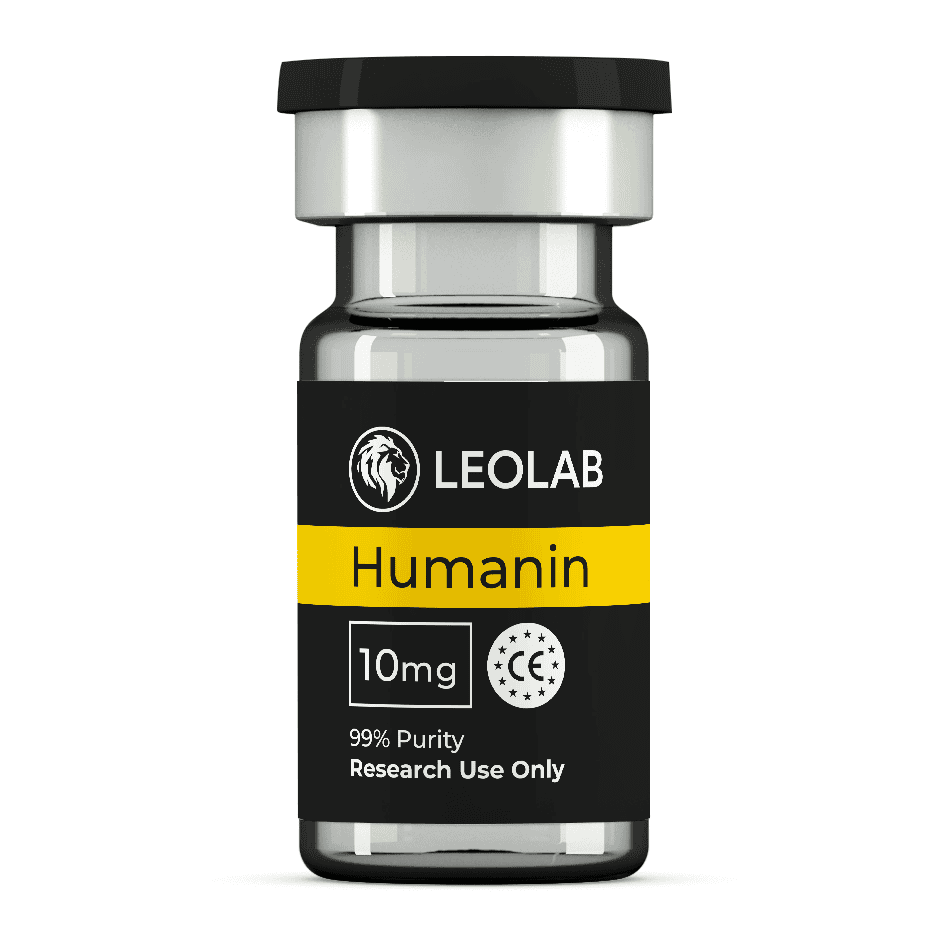
Humanin – Mitochondrial-Derived Peptide for Apoptosis and Metabolic Research
Humanin is a 24-amino-acid peptide with the sequence MAPRGFSCLLLLTSEIDLPVKRRA. It was identified in 2001 through functional expression screening for factors that suppressed neuronal cell death induced by several familial Alzheimer’s disease genes and by amyloid beta in culture. The cDNA was transcribed to the corresponding polypeptide and secreted into the culture medium, and the reported rescue activity depended on the primary structure of the peptide.
The coding sequence maps to a short open reading frame within the mitochondrial 16S ribosomal RNA region, making Humanin the first described member of the class of mitochondrial-derived peptides. Mechanistic work has characterized it both as an intracellular binding partner of pro-apoptotic proteins and as a secreted factor. A separate screen identified a direct interaction with Bax, in which Humanin prevents Bax translocation from the cytosol to mitochondria and blocks Bax association with isolated mitochondria; reducing Humanin expression by RNA interference had the converse effect. Humanin also binds IGFBP-3, which situates it at the interface between apoptosis regulation and IGF signaling.
Later work extended the field to metabolism. In rodents, central infusion of Humanin was studied in relation to insulin action using clamp methodology, and circulating levels of mitochondrial-derived peptides have been examined as age-dependent variables alongside markers of apoptosis and inflammation. All findings described here come from cell culture and animal experiments.
Key Research Areas
Bax-Mediated Apoptosis: Used in cell models to study how Humanin binds Bax, prevents its mitochondrial translocation and suppresses cytochrome c release in vitro.
IGFBP-3 Interaction: Investigated as a binding partner of insulin-like growth factor binding protein 3, a protein with opposing effects on cell survival.
Neuroprotection Models: Examined in neuronal cultures challenged with familial Alzheimer’s disease gene constructs and amyloid beta peptides, with reported specificity relative to other cytotoxic insults.
Mitochondrial-Derived Peptide Biology: Studied as the first identified member of a class of peptides encoded within mitochondrial ribosomal RNA genes, in the context of mitochondrial retrograde signaling.
Metabolic Models: Investigated in rodents in connection with insulin action, using hyperinsulinemic clamp techniques and central administration.
Age-Dependent Regulation: Circulating levels of Humanin and related peptides have been measured across age in animal and human cohort studies as descriptive biomarkers.
Product Details
- Name: Humanin
- Type: Research peptide
- Quantity: 10mg per vial
- Form: Lyophilized powder
- Molecular Formula: C₁₁₉H₂₀₄N₃₄O₃₂S₂
- Molecular Weight: 2687.27 g/mol
- Purity: ≥99%
- Storage: Store at 2–8°C, protected from light and moisture
- Use: For laboratory research use only. Not for human consumption.
Selected literature
- Hashimoto Y., Niikura T., Tajima H., et al. A rescue factor abolishing neuronal cell death by a wide spectrum of familial Alzheimer’s disease genes and Aβ. Proceedings of the National Academy of Sciences USA, 2001;98(11):6336–6341. https://doi.org/10.1073/pnas.101133498
- Guo B., Zhai D., Cabezas E., et al. Humanin peptide suppresses apoptosis by interfering with Bax activation. Nature, 2003;423(6938):456–461. https://doi.org/10.1038/nature01627
- Muzumdar R.H., Huffman D.M., Atzmon G., et al. Humanin: a novel central regulator of peripheral insulin action. PLoS ONE, 2009;4(7):e6334. https://doi.org/10.1371/journal.pone.0006334
- Cobb L.J., Lee C., Xiao J., et al. Naturally occurring mitochondrial-derived peptides are age-dependent regulators of apoptosis, insulin sensitivity, and inflammatory markers. Aging, 2016;8(4):796–809. https://doi.org/10.18632/aging.100943