Description
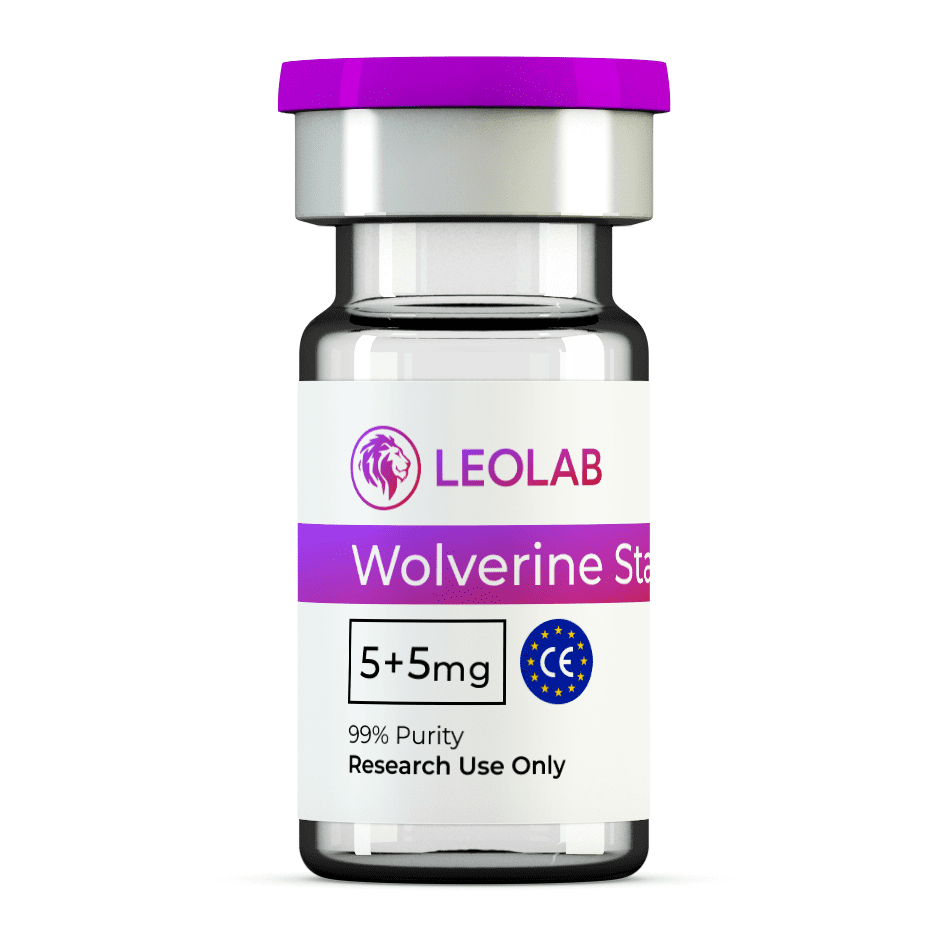
Wolverine Stack (BPC-157 + TB-500) – Tissue Repair Research Peptide Blend
This blend combines two peptides studied independently in models of soft tissue injury. BPC-157 is a synthetic fragment of a protein found in human gastric juice, examined mainly in rat models of tendon, ligament and muscle injury. TB-500 corresponds to thymosin β4, an endogenous polypeptide regarded as the principal intracellular G-actin sequestering peptide, studied in connection with cell migration, angiogenesis and the regulation of inflammation.
The two components act through unrelated mechanisms, and the pairing reflects an overlap in experimental application rather than a documented interaction. No published study characterizes the combination as such; the literature below concerns each peptide separately.
BPC-157
BPC-157 is a pentadecapeptide with the sequence Gly–Glu–Pro–Pro–Pro–Gly–Lys–Pro–Ala–Asp–Asp–Ala–Gly–Leu–Val and the molecular formula C₆₂H₉₈N₁₆O₂₂. It corresponds to a partial sequence of body protection compound, isolated from human gastric juice, and is described as stable in gastric juice beyond 24 hours. In rats, it has been studied in transected Achilles tendon and quadriceps muscle models with biomechanical, functional and histological endpoints, and in ligament injury. In cultured tendon fibroblasts, reported effects include explant outgrowth and cell migration with associated focal adhesion kinase and paxillin signaling.
TB-500 (Thymosin β4)
TB-500 corresponds to thymosin β4, a 43-residue acetylated peptide with the sequence Ac–SDKPDMAEIEKFDKSKLKKTETQEKNPLPSKETIEQEKQAGES and the molecular formula C₂₁₂H₃₅₀N₅₆O₇₈S. The human gene encodes a 44-residue precursor that is processed to the mature 43-residue form by removal of the initiator methionine. Its principal characterized intracellular function is sequestration of monomeric G-actin, mediated in part by the conserved LKKTET motif shared with other β-thymosin isoforms. Extracellular thymosin β4 has been studied in connection with angiogenesis, wound healing and inflammation. It is also the precursor of the tetrapeptide Ac-SDKP, released by sequential cleavage involving meprin α and prolyl oligopeptidase, which is studied separately in organ fibrosis models.
Key Research Areas
Tendon and Ligament Models: BPC-157 is used in rat transection models with load at failure, Young’s modulus and histological scoring as endpoints.
Actin Dynamics: Thymosin β4 is used as a reference G-actin sequestering peptide in studies of cytoskeletal regulation and actin polymerization.
Cell Migration: Both peptides are examined in migration assays, BPC-157 in tendon fibroblasts and thymosin β4 in endothelial and epithelial systems.
Angiogenesis: Thymosin β4 is studied in connection with endothelial cell differentiation and new vessel formation in experimental models.
Fibrosis Pathways: The thymosin β4–prolyl oligopeptidase–Ac-SDKP axis is investigated in models of liver, kidney, lung and cardiac fibrosis.
Peptide Stability: BPC-157 is used as a reference example of a peptide reported to resist degradation in gastric juice without a carrier.
Product Details
- Name: Wolverine Stack (BPC-157 + TB-500)
- Type: Research peptide blend
- Available strengths: 10mg, 20mg
- Form: Lyophilized powder
- Molecular Formula (BPC-157): C₆₂H₉₈N₁₆O₂₂
- Molecular Weight (BPC-157): 1419.56 g/mol
- Molecular Formula (TB-500): C₂₁₂H₃₅₀N₅₆O₇₈S
- Molecular Weight (TB-500): 4963.51 g/mol
- Purity: ≥98% (HPLC verified)
- Storage: Store at 2–8°C, protected from light and moisture
- Use: For laboratory research use only. Not for human consumption.
Selected literature
- Staresinic M., Sebecic B., Patrlj L., et al. Gastric pentadecapeptide BPC 157 accelerates healing of transected rat Achilles tendon and in vitro stimulates tendocytes growth. Journal of Orthopaedic Research, 2003;21(6):976–983. https://doi.org/10.1016/S0736-0266(03)00110-4
- Cerovecki T., Bojanic I., Brcic L., et al. Pentadecapeptide BPC 157 (PL 14736) improves ligament healing in the rat. Journal of Orthopaedic Research, 2010;28(9):1155–1161. https://doi.org/10.1002/jor.21107
- Chang C.H., Tsai W.C., Lin M.S., Hsu Y.H., Pang J.H.S. The promoting effect of pentadecapeptide BPC 157 on tendon healing involves tendon outgrowth, cell survival, and cell migration. Journal of Applied Physiology, 2011;110(3):774–780. https://doi.org/10.1152/japplphysiol.00945.2010
- Wang S., Lu Y., Chi T., et al. The role of Tβ4-POP-Ac-SDKP axis in organ fibrosis. International Journal of Molecular Sciences, 2022;23(21):13282. https://doi.org/10.3390/ijms232113282