Description
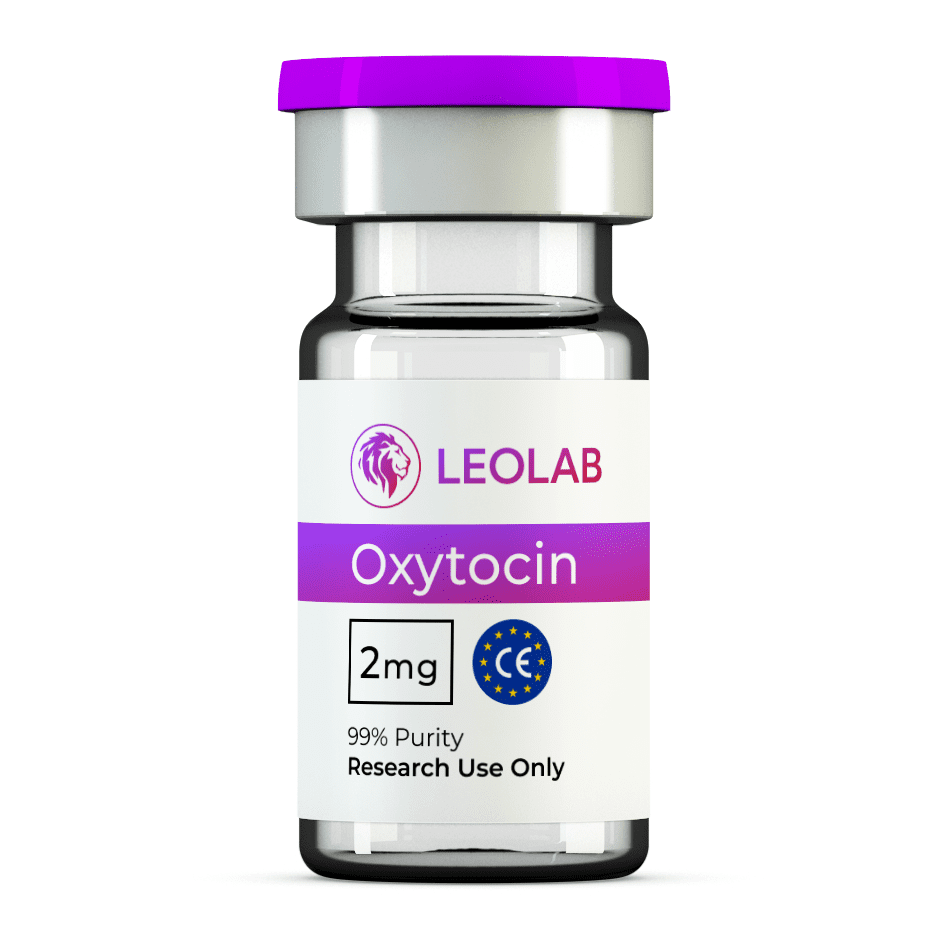
Oxytocin – Nonapeptide Hormone Research Peptide
Oxytocin is a cyclic nonapeptide with the sequence Cys–Tyr–Ile–Gln–Asn–Cys–Pro–Leu–Gly–NH₂, cyclized through a disulfide bond between the two cysteine residues and amidated at the carboxy terminus. Its amino acid sequence was determined in 1953, and it holds a particular place in peptide chemistry as the first peptide hormone to be chemically synthesized, which established that a biologically active hormone could be reproduced from defined chemical steps.
The major site of expression is the magnocellular neurons of the hypothalamic paraventricular and supraoptic nuclei, from which the peptide reaches the posterior pituitary. Oxytocinergic projections are distributed widely through the central nervous system, and additional synthesis occurs in peripheral tissues including uterus, placenta and testis. The peptide acts through a single receptor, a class I G protein-coupled receptor coupled via Gq proteins to phospholipase C-beta.
Two features of the receptor make it a frequent subject of biophysical work. Its high-affinity state requires both magnesium and cholesterol, which are proposed to act as allosteric modulators, and regulation of the whole system is strongly steroid-dependent, which makes it a model case for hormonal control of neuropeptide and receptor expression. Classical experimental endpoints are uterine smooth muscle contraction and milk ejection, both of which have been studied in oxytocin-deficient mouse lines.
Key Research Areas
Receptor Pharmacology: Used to study ligand binding, Gq-phospholipase C coupling and the allosteric contributions of magnesium and cholesterol to receptor affinity.
Smooth Muscle Physiology: Applied in classical uterine contraction preparations, one of the oldest quantitative bioassays in endocrinology.
Knockout Models: Examined in oxytocin-deficient mice, where milk ejection and parturition endpoints separate essential from redundant functions.
Steroid Regulation: Investigated as a model of how gonadal and adrenal steroids control neuropeptide and receptor expression.
Peptide Synthesis History: Serves as the reference case in the development of solution-phase peptide synthesis and disulfide-bridged cyclization.
Central Nervous System Distribution: Studied in mapping work on oxytocinergic projections and extrahypothalamic receptor expression.
Product Details
- Name: Oxytocin
- Type: Research peptide
- Quantity: 2mg per vial
- Form: Lyophilized powder
- Molecular Formula: C₄₃H₆₆N₁₂O₁₂S₂
- Molecular Weight: 1007.19 g/mol
- Purity: ≥98% (HPLC verified)
- Storage: Store at 2–8°C, protected from light and moisture
- Use: For laboratory research use only. Not for human consumption.
Selected literature
- du Vigneaud V., Ressler C., Trippett S. The sequence of amino acids in oxytocin, with a proposal for the structure of oxytocin. Journal of Biological Chemistry, 1953;205(2):949–957. https://doi.org/10.1016/S0021-9258(18)49238-1
- Gimpl G., Fahrenholz F. The oxytocin receptor system: structure, function, and regulation. Physiological Reviews, 2001;81(2):629–683. https://doi.org/10.1152/physrev.2001.81.2.629