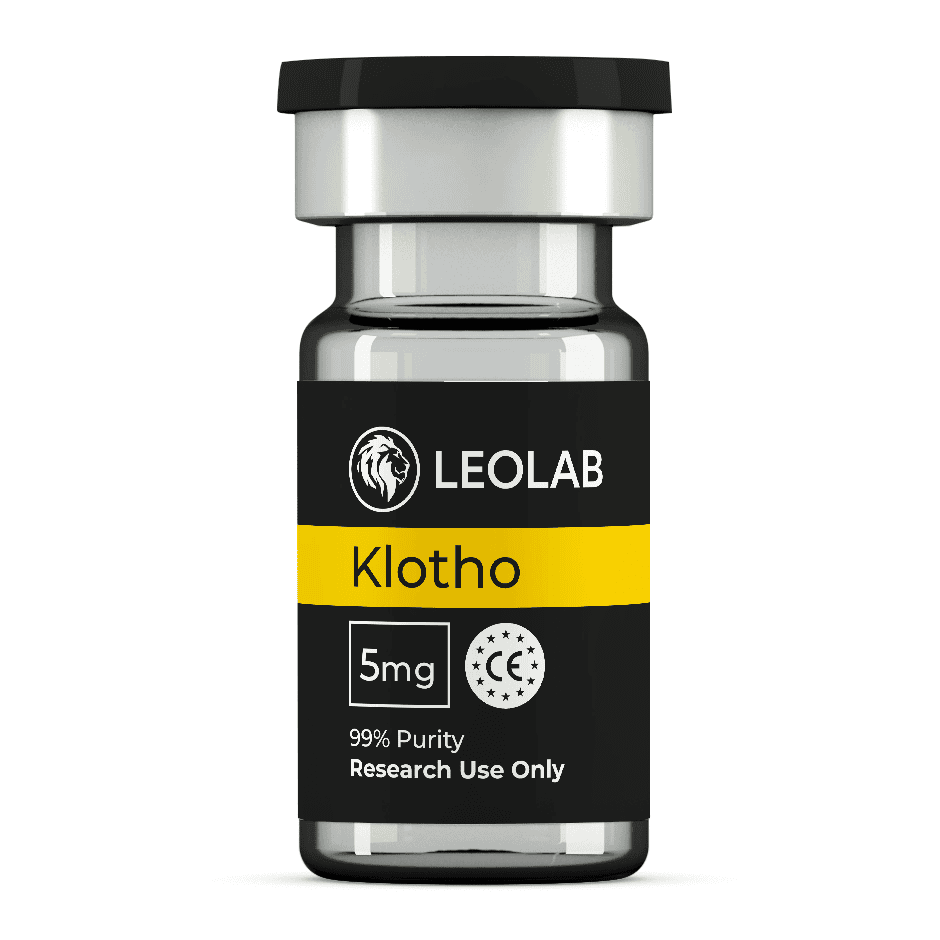
Description
Klotho – FGF23 Co-Receptor and Aging-Pathway Research Peptide
Klotho (α-Klotho) entered the research literature in 1997, when disruption of the klotho gene in mice produced a syndrome resembling accelerated aging, including shortened lifespan, arteriosclerosis, skin atrophy, osteoporosis and emphysema. The gene was described as encoding a membrane protein with sequence similarity to β-glucosidase enzymes, and was proposed to act within a signaling pathway relevant to aging phenotypes in vivo. This initial report established Klotho as a subject of investigation in experimental gerontology, and subsequent work has broadened the field to renal physiology, mineral metabolism and neuroscience.
The membrane-bound form is studied as an obligate co-receptor for FGF23: in cell models, Klotho converts FGFR1(IIIc) into a receptor capable of high-affinity FGF23 binding, which is the proposed mechanism by which the bone-derived hormone FGF23 acts on the kidney. A soluble form, released from the cell surface by ectodomain shedding, has been detected in serum and cerebrospinal fluid and is studied as a circulating factor. Because the native protein is large and exists in more than one form, Klotho is described here strictly as an object of study; no claim is made about the correspondence between published preparations and any particular material.
Key Research Areas
FGF23–FGFR–Klotho Complex: Used in cell and animal models to examine how Klotho confers FGF23 specificity on canonical FGF receptors, and how the resulting complex relates to phosphate handling and vitamin D metabolism in the kidney.
Mineral Metabolism: Investigated in preclinical models in connection with phosphate excretion, vitamin D biosynthesis, and calcium balance, including models of impaired renal function.
Oxidative Stress Response: Studied in cell and mouse models where Klotho is associated with activation of FoxO forkhead transcription factors and induction of manganese superoxide dismutase, and with increased resistance to oxidative stress at the cellular and organismal level.
Insulin/IGF-1 Signaling: Examined in mouse models in which Klotho overexpression extended lifespan and was associated with repression of intracellular insulin and IGF-1 signaling.
Wnt Signaling and Cellular Senescence: Explored in the Klotho mouse model of accelerated aging, where Klotho has been characterized as a secreted Wnt antagonist and where augmented Wnt exposure was linked to progenitor-cell senescence.
Neuroscience Models: Studied in rodent work in connection with synaptic plasticity, hippocampal NMDA receptor subunit composition, and performance in learning and memory tasks.
Product Details
- Name: Klotho
- Type: Research peptide
- Quantity: 5mg per vial
- Form: Lyophilized powder
- Purity: ≥99%
- Storage: Store at 2–8°C, protected from light and moisture
- Use: For laboratory research use only. Not for human consumption.
Selected literature
- Kuro-o M., Matsumura Y., Aizawa H., et al. Mutation of the mouse klotho gene leads to a syndrome resembling ageing. Nature, 1997;390(6655):45–51. https://doi.org/10.1038/36285
- Kurosu H., Yamamoto M., Clark J.D., et al. Suppression of aging in mice by the hormone Klotho. Science, 2005;309(5742):1829–1833. https://doi.org/10.1126/science.1112766
- Urakawa I., Yamazaki Y., Shimada T., et al. Klotho converts canonical FGF receptor into a specific receptor for FGF23. Nature, 2006;444(7120):770–774. https://doi.org/10.1038/nature05315
- Yamamoto M., Clark J.D., Pastor J.V., et al. Regulation of oxidative stress by the anti-aging hormone klotho. Journal of Biological Chemistry, 2005;280(45):38029–38034. https://doi.org/10.1074/jbc.M509039200
- Liu H., Fergusson M.M., Castilho R.M., et al. Augmented Wnt signaling in a mammalian model of accelerated aging. Science, 2007;317(5839):803–806. https://doi.org/10.1126/science.1143578
- Dubal D.B., Yokoyama J.S., Zhu L., et al. Life extension factor klotho enhances cognition. Cell Reports, 2014;7(4):1065–1076. https://doi.org/10.1016/j.celrep.2014.03.076