Description
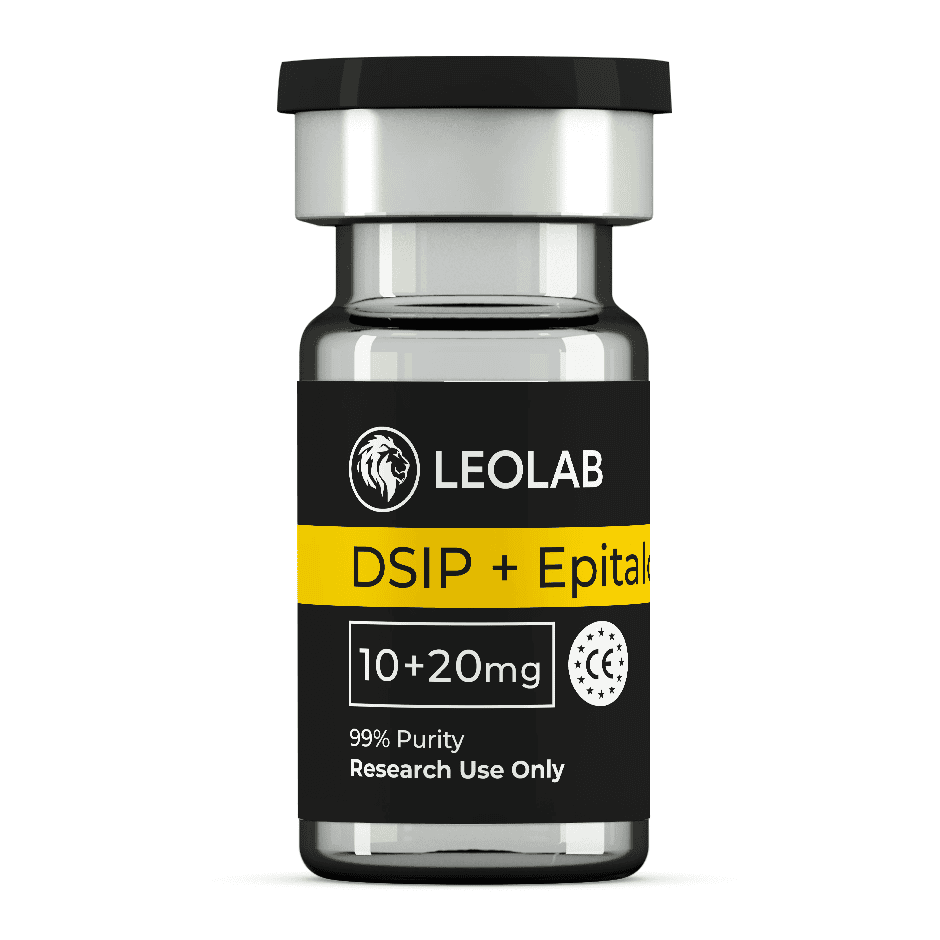
DSIP + Epithalon – Sleep-Regulation and Telomere Biology Research Blend
This blend pairs two short peptides that are studied in separate but adjacent areas of preclinical research. DSIP (delta sleep-inducing peptide) was isolated in the 1970s during attempts to identify a humoral sleep factor, and is examined in animal models in connection with slow-wave EEG activity, stress-response regulation and neuroendocrine signaling. Epithalon (Ala-Glu-Asp-Gly, AEDG) is a synthetic tetrapeptide based on the amino acid composition of the pineal preparation epithalamin, and is studied in cell culture in connection with telomerase activity, telomere length and replicative senescence.
The two components are frequently discussed together in the literature on circadian and pineal regulation, which is the basis for supplying them as a single research blend. Findings for both peptides derive from cell culture and animal experiments, and the mechanisms underlying the reported observations remain incompletely characterized.
DSIP (Delta Sleep-Inducing Peptide)
DSIP is a nonapeptide with the sequence Trp–Ala–Gly–Gly–Asp–Ala–Ser–Gly–Glu and the molecular formula C₃₅H₄₈N₁₀O₁₅. It was isolated from the cerebral venous blood of rabbits subjected to hypnogenic thalamic stimulation, and the synthetic nonapeptide was reported to enhance delta and spindle EEG patterns after intraventricular infusion under double-blind conditions. Later reviews surveyed a broad set of reported activities beyond EEG effects, including endocrine and thermoregulatory observations. The mechanism of action remains uncharacterized: no gene, precursor protein or receptor for DSIP has been isolated, and the peptide continues to be a subject of mechanistic investigation.
Epithalon (AEDG Tetrapeptide)
Epithalon is a synthetic tetrapeptide with the sequence Ala–Glu–Asp–Gly and the molecular formula C₁₄H₂₂N₄O₉. In telomerase-negative human fetal fibroblast cultures, Epithalon treatment was reported to induce expression of the telomerase catalytic subunit, enzymatic telomerase activity and telomere elongation; a follow-up study reported that treated cultures continued dividing past the passage at which control cultures ceased. An independent 2025 cell-line study reported dose-dependent telomere length extension in normal human mammary epithelial and fibroblast lines through hTERT and telomerase upregulation, with a different mechanism in the breast cancer lines tested. Rodent work from the same research group has examined lifespan parameters, chromosome aberration frequency and spontaneous tumor development under varying light regimens.
Key Research Areas
Slow-Wave Sleep Models: DSIP is studied in rabbits, rats and other species in connection with delta and spindle EEG activity following central administration.
Neuroendocrine and Stress Regulation: Reviewed literature describes DSIP effects on hormonal parameters and stress-related measures in animal models, alongside EEG observations.
Telomerase and Telomere Length: Epithalon is used in cell culture studies examining hTERT expression, telomerase enzymatic activity and telomere length in normal and transformed human cell lines.
Replicative Senescence: Investigated in human fibroblast cultures in connection with proliferative potential and the number of population doublings achieved before growth arrest.
Circadian and Pineal Research: Both peptides are studied in relation to pineal function and light-regimen manipulation in rodent models, including work on lifespan parameters under constant and natural illumination.
Mechanistic Characterization: DSIP remains a target for receptor and precursor identification; Epithalon is a subject of ongoing replication work outside its original research group.
Product Details
- Name: DSIP + Epithalon
- Type: Research peptide blend
- Quantity: 10mg DSIP + 20mg Epithalon per vial
- Form: Lyophilized powder
- Molecular Formula (DSIP): C₃₅H₄₈N₁₀O₁₅
- Molecular Weight (DSIP): 848.82 g/mol
- Molecular Formula (Epithalon): C₁₄H₂₂N₄O₉
- Molecular Weight (Epithalon): 390.35 g/mol
- Purity: ≥99%
- Storage: Store at 2–8°C, protected from light and moisture
- Use: For laboratory research use only. Not for human consumption.
Selected literature
- Schoenenberger G.A., Monnier M. Characterization of a delta-electroencephalogram (-sleep)-inducing peptide. Proceedings of the National Academy of Sciences USA, 1977;74(3):1282–1286. https://doi.org/10.1073/pnas.74.3.1282
- Graf M.V., Kastin A.J. Delta-sleep-inducing peptide (DSIP): a review. Neuroscience & Biobehavioral Reviews, 1984;8(1):83–93. https://doi.org/10.1016/0149-7634(84)90022-8
- Kovalzon V.M., Strekalova T.V. Delta sleep-inducing peptide (DSIP): a still unresolved riddle. Journal of Neurochemistry, 2006;97(2):303–309. https://doi.org/10.1111/j.1471-4159.2006.03693.x
- Khavinson V.Kh., Bondarev I.E., Butyugov A.A. Epithalon peptide induces telomerase activity and telomere elongation in human somatic cells. Bulletin of Experimental Biology and Medicine, 2003;135(6):590–592. https://doi.org/10.1023/A:1025493705728
- Al-dulaimi S., Thomas R., Matta S., Roberts T. Epitalon increases telomere length in human cell lines through telomerase upregulation or ALT activity. Biogerontology, 2025;26(5):178. https://doi.org/10.1007/s10522-025-10315-x