Description
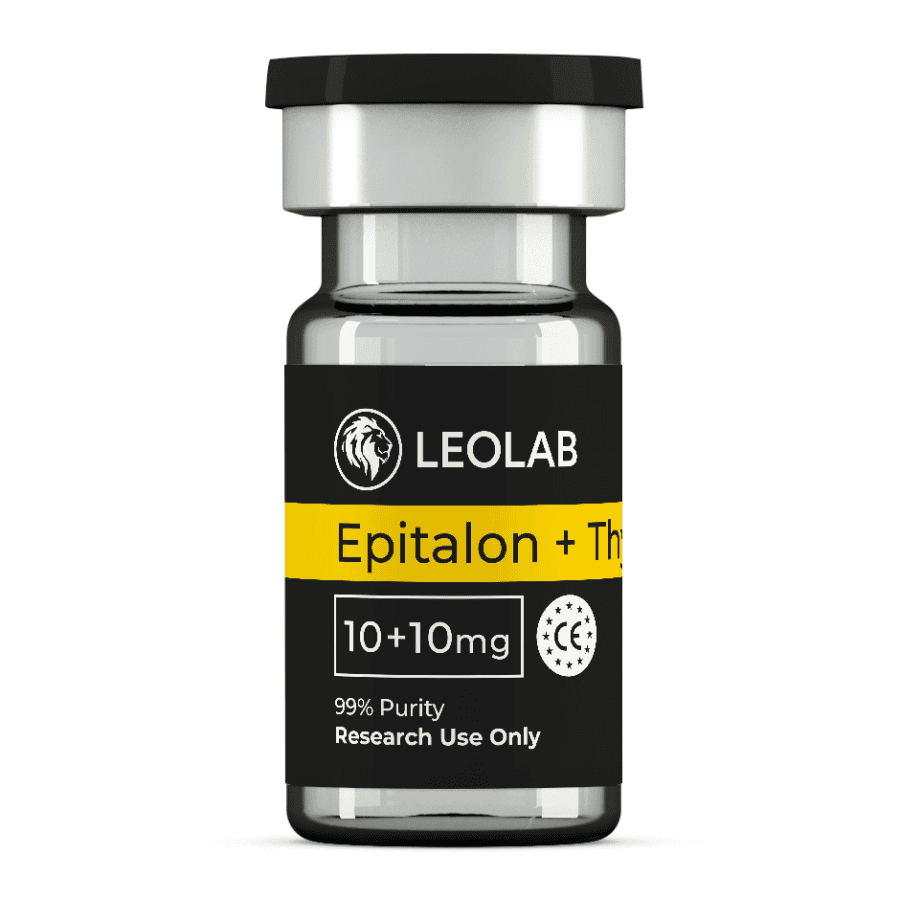
Epithalon + Pinealon – Short Peptide Bioregulators for Telomere and Neuroprotection Research
This blend combines two short synthetic peptides developed within the same Russian research program on peptide bioregulators. Epithalon is studied in human cell culture in connection with telomerase activity, telomere length and replicative senescence. Pinealon is studied in neuronal and non-neuronal cell preparations and in rodents in connection with reactive oxygen species accumulation, cell viability and ERK 1/2 signaling.
Both peptides belong to the class of ultrashort peptides proposed to act at the level of gene expression rather than through a classical receptor, and the two are often examined side by side in the same experimental series. The evidence base for each is preclinical, and in both cases the proposed mechanisms remain under investigation.
Epithalon (AEDG Tetrapeptide)
Epithalon is a synthetic tetrapeptide with the sequence Ala–Glu–Asp–Gly and the molecular formula C₁₄H₂₂N₄O₉, based on the amino acid composition of the pineal preparation epithalamin. In telomerase-negative human fetal fibroblast cultures, treatment was reported to induce expression of the telomerase catalytic subunit, enzymatic telomerase activity and telomere elongation; a follow-up study reported that treated cultures continued dividing past the passage at which controls arrested. An independent 2025 study in human cell lines reported dose-dependent telomere length extension in normal mammary epithelial and fibroblast lines through hTERT and telomerase upregulation, with a different mechanism in the breast cancer lines tested.
Pinealon (EDR Tripeptide)
Pinealon is a synthetic tripeptide with the sequence Glu–Asp–Arg and the molecular formula C₁₅H₂₆N₆O₈. Its sequence corresponds to a motif found in Cortexin, a polypeptide complex prepared from cerebral cortex. In cerebellar granule cells, neutrophils and PC12 cells, Pinealon was reported to restrict reactive oxygen species accumulation in a dose-dependent manner and to reduce necrotic cell death measured by propidium iodide staining, with an accompanying delay in ERK 1/2 activation and modification of the cell cycle. The authors proposed direct interaction with the cell genome alongside antioxidant activity. In rodents, Pinealon has been examined in a prenatal hyperhomocysteinemia model, where offspring performance in spatial tasks and the oxidative-stress resistance of isolated cerebellar neurons were assessed.
Key Research Areas
Telomerase and Telomere Length: Epithalon is used in cell culture studies measuring hTERT expression, telomerase enzymatic activity and telomere length in normal and transformed human cell lines.
Replicative Senescence: Investigated in human fibroblast cultures in connection with proliferative potential and the number of population doublings before growth arrest.
Oxidative Stress in Neurons: Pinealon is studied in cerebellar granule cell preparations exposed to ouabain or homocysteine, with intracellular reactive oxygen species as the primary readout.
Cell Cycle and ERK Signaling: Examined in PC12 cells, where cell cycle distribution and the time course of ERK 1/2 phosphorylation were measured across a concentration range.
Prenatal Stress Models: Pinealon has been investigated in rat offspring exposed to prenatal hyperhomocysteinemia, with behavioral and ex vivo neuronal endpoints.
Peptide–Genome Interaction: Both peptides are studied within the hypothesis that ultrashort peptides enter cells and interact with DNA or chromatin proteins, a mechanism that remains under investigation.
Product Details
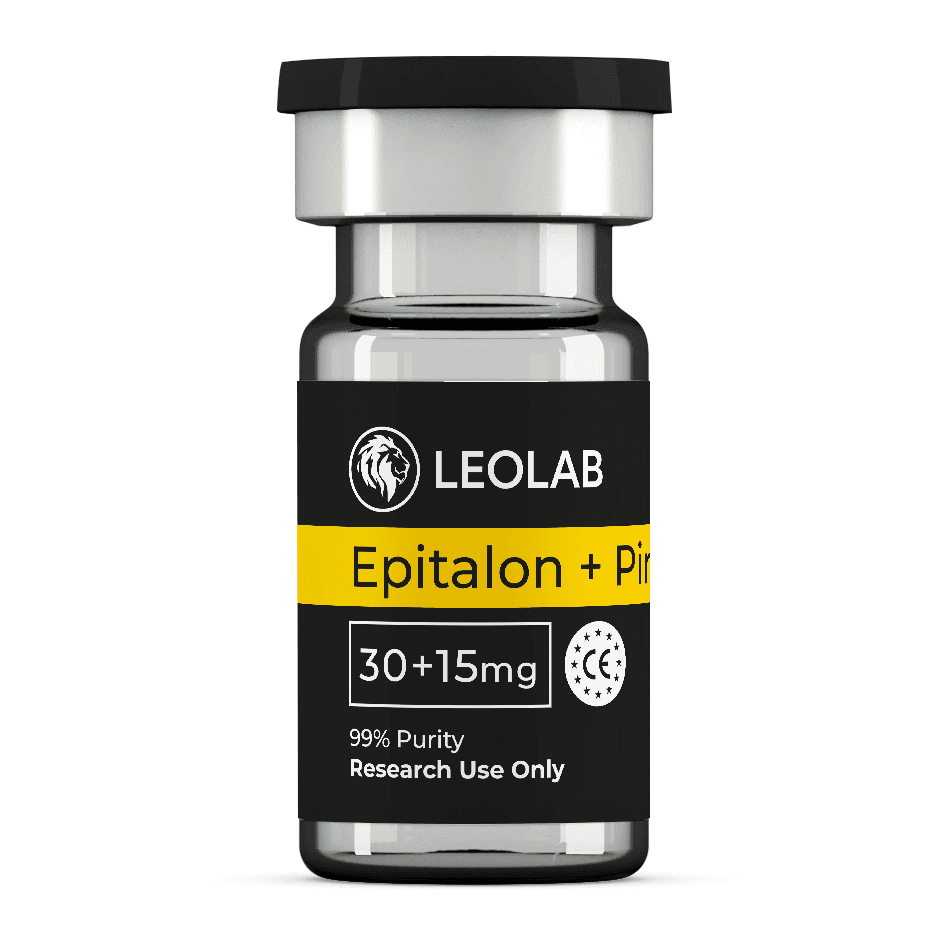
- Name: Epithalon + Pinealon
- Type: Research peptide blend
- Quantity: 30mg Epithalon + 15mg Pinealon per vial
- Form: Lyophilized powder
- Molecular Formula (Epithalon): C₁₄H₂₂N₄O₉
- Molecular Weight (Epithalon): 390.35 g/mol
- Molecular Formula (Pinealon): C₁₅H₂₆N₆O₈
- Molecular Weight (Pinealon): 418.41 g/mol
- Purity: ≥99%
- Storage: Store at 2–8°C, protected from light and moisture
- Use: For laboratory research use only. Not for human consumption.
Selected literature
- Khavinson V.Kh., Bondarev I.E., Butyugov A.A. Epithalon peptide induces telomerase activity and telomere elongation in human somatic cells. Bulletin of Experimental Biology and Medicine, 2003;135(6):590–592. https://doi.org/10.1023/A:1025493705728
- Khavinson V.Kh., Bondarev I.E., Butyugov A.A., Smirnova T.D. Peptide promotes overcoming of the division limit in human somatic cell. Bulletin of Experimental Biology and Medicine, 2004;137(5):503–506. https://doi.org/10.1023/B:BEBM.0000038164.49947.8c
- Al-dulaimi S., Thomas R., Matta S., Roberts T. Epitalon increases telomere length in human cell lines through telomerase upregulation or ALT activity. Biogerontology, 2025;26(5):178. https://doi.org/10.1007/s10522-025-10315-x
- Khavinson V., Ribakova Y., Kulebiakin K., et al. Pinealon increases cell viability by suppression of free radical levels and activating proliferative processes. Rejuvenation Research, 2011;14(5):535–541. https://doi.org/10.1089/rej.2011.1172
- Arutjunyan A., Kozina L., Stvolinskiy S., et al. Pinealon protects the rat offspring from prenatal hyperhomocysteinemia. International Journal of Clinical and Experimental Medicine, 2012;5(2):179–185. https://pubmed.ncbi.nlm.nih.gov/22567179/