Description
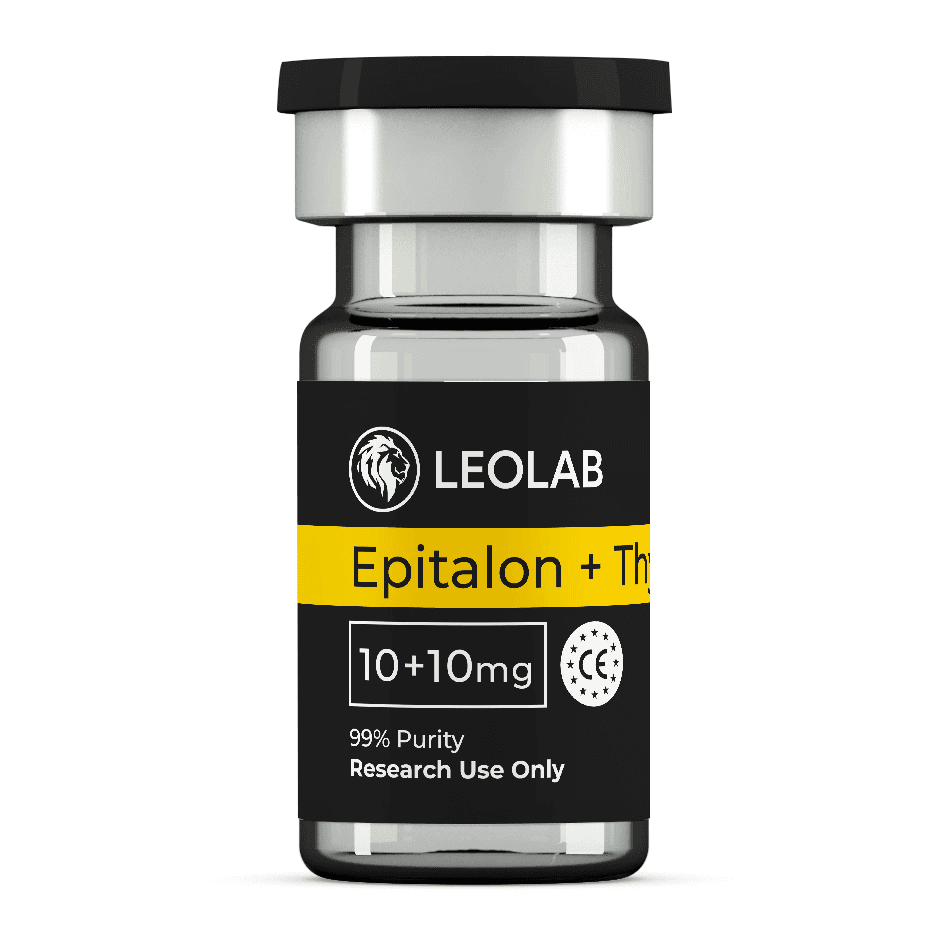
Epithalon + Thymalin – Pineal and Thymic Peptide Preparations for Research
This blend combines a defined synthetic tetrapeptide with a thymus-derived peptide complex, two preparations developed within the same Russian research program on peptide bioregulators. Epithalon is studied in human cell culture in connection with telomerase activity, telomere length and replicative senescence. Thymalin is studied as an immunomodulatory preparation obtained from calf thymus by mild acid extraction.
The pairing reflects the historical structure of that research program, in which pineal-derived and thymus-derived preparations were investigated in parallel as candidate regulators of age-associated change. The two components differ fundamentally in their chemical definition: Epithalon is a single tetrapeptide of known sequence, whereas Thymalin is a mixture of thymus-derived peptides with no single sequence. This distinction matters for experimental design, since the composition of a complex preparation is batch-dependent and is not fully characterized in the published literature.
Epithalon (AEDG Tetrapeptide)
Epithalon is a synthetic tetrapeptide with the sequence Ala–Glu–Asp–Gly and the molecular formula C₁₄H₂₂N₄O₉, based on the amino acid composition of the pineal preparation epithalamin. In telomerase-negative human fetal fibroblast cultures, treatment was reported to induce expression of the telomerase catalytic subunit, enzymatic telomerase activity and telomere elongation. A follow-up study reported that treated cultures continued dividing past the passage at which control cultures arrested. An independent 2025 study in human cell lines reported dose-dependent telomere length extension in normal mammary epithelial and fibroblast lines through hTERT and telomerase upregulation, with a different mechanism in the breast cancer lines tested.
Thymalin (Thymus Peptide Complex)
Thymalin is a thymus-derived peptide complex with no single sequence and no defined molecular formula. It was obtained from calf thymus by mild acid extraction and described in the literature as an immunocorrector. One component, the dipeptide L-Glu-L-Trp, was subsequently isolated from Thymalin by reversed-phase high-performance liquid chromatography and developed separately as a defined synthetic preparation, which is the clearest documented link between the complex and a single characterized molecule. Because Thymalin is a mixture rather than a single compound, published work describes the activity of the preparation as a whole rather than that of an identified active principle.
Key Research Areas
Telomerase and Telomere Length: Epithalon is used in cell culture studies measuring hTERT expression, telomerase enzymatic activity and telomere length in normal and transformed human cell lines.
Replicative Senescence: Investigated in human fibroblast cultures in connection with proliferative potential and the number of population doublings before growth arrest.
Thymic Peptide Immunomodulation: Thymalin is studied as a naturally derived thymic peptide preparation in experimental models of immune dysfunction.
Fractionation of Complex Preparations: The isolation of L-Glu-L-Trp from Thymalin is used as a reference example of resolving a peptide complex into defined synthetic components.
Natural Versus Synthetic Thymic Peptides: Comparative work has examined naturally extracted thymic peptides alongside their synthetic counterparts in the same experimental systems.
Combined Peptide Models: Pineal and thymic preparations have been examined in parallel within the same rodent research programs on age-associated biological change.
Product Details
- Name: Epithalon + Thymalin
- Type: Research peptide blend
- Quantity: 10mg Epithalon + 10mg Thymalin per vial
- Form: Lyophilized powder
- Molecular Formula (Epithalon): C₁₄H₂₂N₄O₉
- Molecular Weight (Epithalon): 390.35 g/mol
- Purity: ≥99%
- Storage: Store at 2–8°C, protected from light and moisture
- Use: For laboratory research use only. Not for human consumption.
Thymalin is a thymus-derived peptide complex with no single sequence; no molecular formula or molecular weight is stated for it.
Selected literature
- Khavinson V.Kh., Bondarev I.E., Butyugov A.A. Epithalon peptide induces telomerase activity and telomere elongation in human somatic cells. Bulletin of Experimental Biology and Medicine, 2003;135(6):590–592. https://doi.org/10.1023/A:1025493705728
- Khavinson V.Kh., Bondarev I.E., Butyugov A.A., Smirnova T.D. Peptide promotes overcoming of the division limit in human somatic cell. Bulletin of Experimental Biology and Medicine, 2004;137(5):503–506. https://doi.org/10.1023/B:BEBM.0000038164.49947.8c
- Al-dulaimi S., Thomas R., Matta S., Roberts T. Epitalon increases telomere length in human cell lines through telomerase upregulation or ALT activity. Biogerontology, 2025;26(5):178. https://doi.org/10.1007/s10522-025-10315-x
- Morozov V.G., Khavinson V.Kh. Natural and synthetic thymic peptides as therapeutics for immune dysfunction. International Journal of Immunopharmacology, 1997;19(9–10):501–505. https://doi.org/10.1016/S0192-0561(97)00058-1