Description
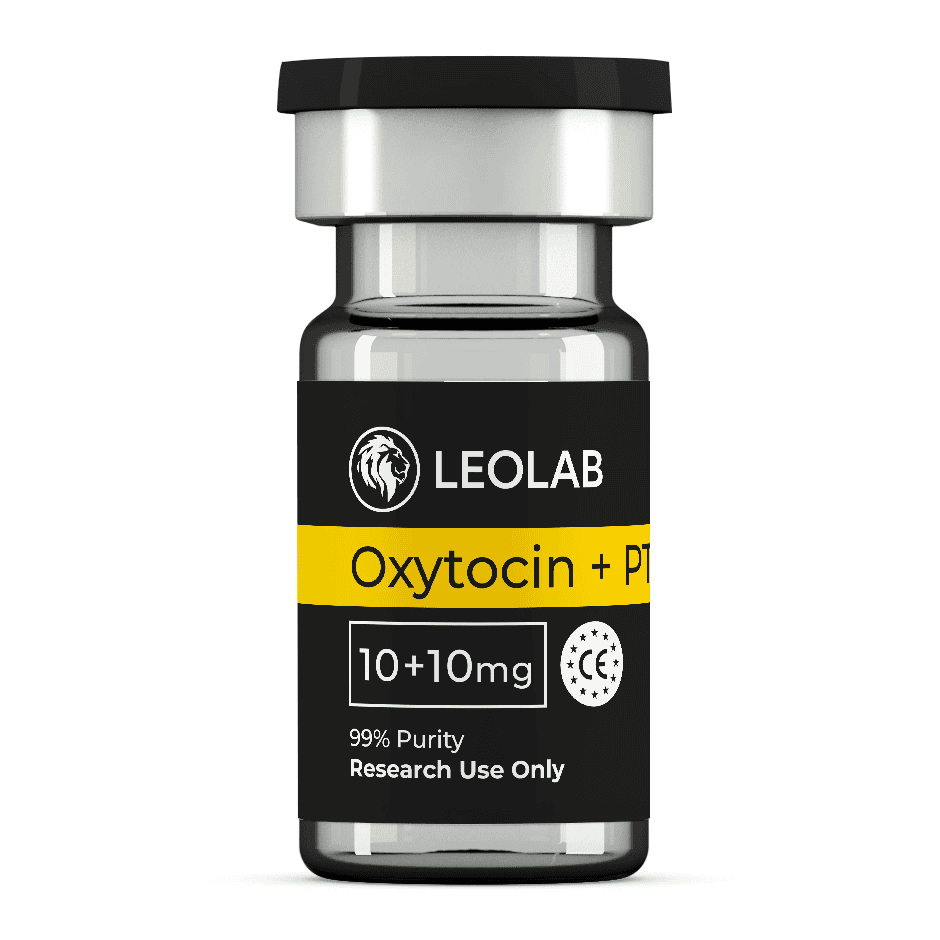
Oxytocin + PT141 – Neuropeptide and Melanocortin Receptor Research Blend
This blend combines two peptides that act on distinct receptor systems with overlapping areas of behavioral research. Oxytocin is an endogenous nonapeptide produced in the hypothalamus and released from the posterior pituitary, acting through a single class I G protein-coupled receptor. PT141, also known as bremelanotide, is a synthetic cyclic heptapeptide analog of α-melanocyte-stimulating hormone that acts as an agonist at melanocortin receptors, principally MC3R and MC4R.
Both peptides are studied in relation to centrally mediated behavior, which is why they are supplied together as a research blend. Their mechanisms are unrelated: oxytocin signals through the oxytocin receptor coupled via Gq proteins to phospholipase C-beta, whereas PT141 engages melanocortin receptors concentrated in hypothalamic and limbic regions. The preclinical literature for each is substantial and largely independent.
Oxytocin
Oxytocin is a cyclic nonapeptide with the sequence Cys–Tyr–Ile–Gln–Asn–Cys–Pro–Leu–Gly–NH₂, cyclized through a disulfide bond, and the molecular formula C₄₃H₆₆N₁₂O₁₂S₂. Its sequence was determined in 1953, and it was the first peptide hormone to be chemically synthesized. The major site of expression is the magnocellular neurons of the hypothalamic paraventricular and supraoptic nuclei, with oxytocinergic projections distributed widely through the central nervous system and additional synthesis in peripheral tissues including uterus, placenta and testis. The high-affinity state of the receptor requires both magnesium and cholesterol, which are proposed to act as allosteric modulators, and regulation of the system is strongly steroid-dependent. Classical experimental endpoints include uterine smooth muscle contraction and milk ejection.
PT141 (Bremelanotide)
PT141 is a synthetic cyclic heptapeptide with the structure Ac–Nle–cyclo[Asp–His–D-Phe–Arg–Trp–Lys]–OH, cyclized through a lactam bridge between the aspartate and lysine side chains, and the molecular formula C₅₀H₆₈N₁₄O₁₀. It is an agonist at melanocortin receptors including MC3R and MC4R, which are expressed primarily in the central nervous system. In rats and nonhuman primates, systemic administration has been reported to produce penile erections, and in rats it increased c-Fos immunoreactivity in the hypothalamus, consistent with central neuronal activation. A separate study in ovariectomized female rats reported selective facilitation of solicitational behaviors.
Key Research Areas
Oxytocin Receptor Pharmacology: Used to study ligand binding, Gq-phospholipase C coupling, and the allosteric roles of magnesium and cholesterol in receptor affinity.
Smooth Muscle and Reproductive Physiology: Examined in classical preparations measuring uterine contraction and milk ejection, including in oxytocin-deficient mice.
Steroid Regulation of Peptide Systems: Investigated as a model of how gonadal and adrenal steroids regulate neuropeptide and receptor expression.
Melanocortin Receptor Signaling: PT141 is used as a centrally acting MC3R/MC4R agonist to distinguish central from peripheral vascular mechanisms in experimental systems.
Central Neuronal Activation Mapping: Studied in rats using c-Fos immunoreactivity to localize hypothalamic responses to systemic peptide administration.
Rodent Behavioral Models: Examined in male and female rodent paradigms measuring appetitive and consummatory behaviors under controlled hormonal conditions.
Product Details
- Name: Oxytocin + PT141
- Type: Research peptide blend
- Quantity: 10mg Oxytocin + 10mg PT141 per vial
- Form: Lyophilized powder
- Molecular Formula (Oxytocin): C₄₃H₆₆N₁₂O₁₂S₂
- Molecular Weight (Oxytocin): 1007.19 g/mol
- Molecular Formula (PT141): C₅₀H₆₈N₁₄O₁₀
- Molecular Weight (PT141): 1025.18 g/mol
- Purity: ≥99%
- Storage: Store at 2–8°C, protected from light and moisture
- Use: For laboratory research use only. Not for human consumption.
Selected literature
- du Vigneaud V., Ressler C., Trippett S. The sequence of amino acids in oxytocin, with a proposal for the structure of oxytocin. Journal of Biological Chemistry, 1953;205(2):949–957. https://doi.org/10.1016/S0021-9258(18)49238-1
- Gimpl G., Fahrenholz F. The oxytocin receptor system: structure, function, and regulation. Physiological Reviews, 2001;81(2):629–683. https://doi.org/10.1152/physrev.2001.81.2.629
- Molinoff P.B., Shadiack A.M., Earle D., Diamond L.E., Quon C.Y. PT-141: a melanocortin agonist for the treatment of sexual dysfunction. Annals of the New York Academy of Sciences, 2003;994:96–102. https://doi.org/10.1111/j.1749-6632.2003.tb03167.x
- Pfaus J.G., Shadiack A., Van Soest T., Tse M., Molinoff P. Selective facilitation of sexual solicitation in the female rat by a melanocortin receptor agonist. Proceedings of the National Academy of Sciences USA, 2004;101(27):10201–10204. https://doi.org/10.1073/pnas.0400491101