Description
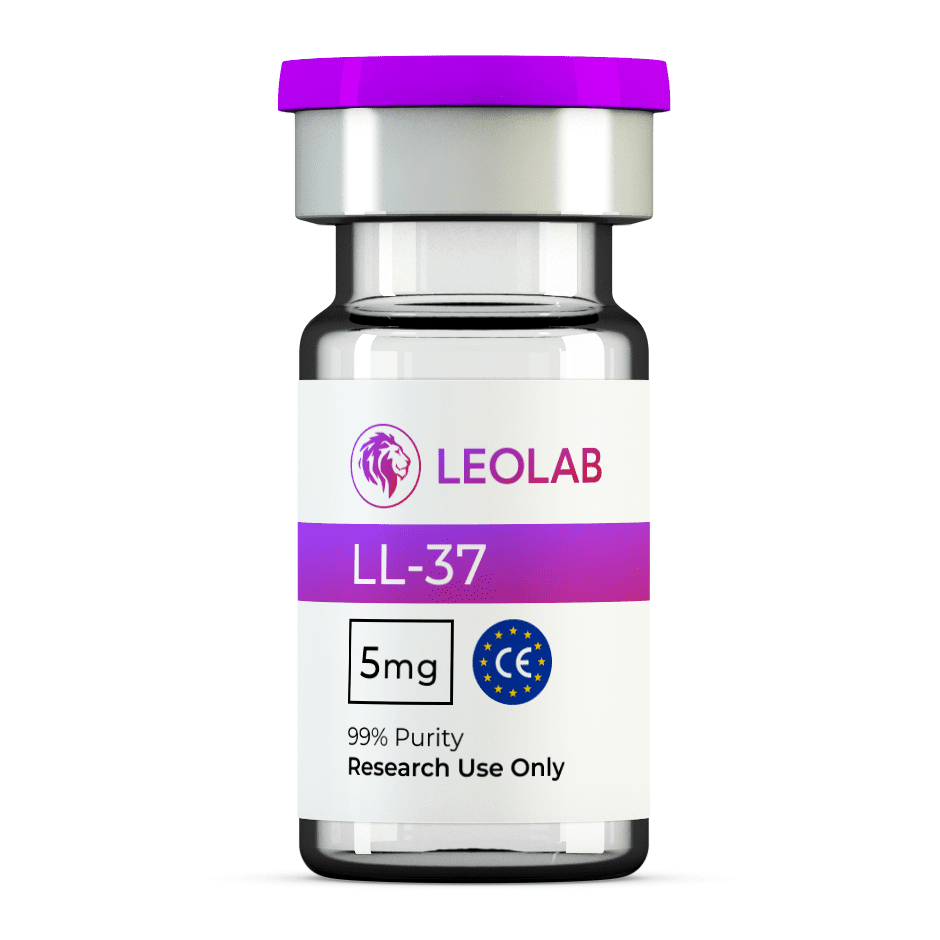
LL-37 – Human Cathelicidin Antimicrobial Peptide
LL-37 is a peptide of 37 residues with the sequence LLGDFFRKSKEKIGKEFKRIVQRIKDFLRNLVPRTES. It was identified in 1995 during an attempt to clone a human counterpart to PR-39, a proline and arginine rich peptide antibiotic purified from pig intestine. Screening a human bone marrow cDNA library with a probe derived from the PR-39 gene returned clones for a different peptide, originally designated FALL-39 after its first four residues; the mature form beginning with the two leucines is the one in general use.
Its structural distinction was apparent immediately. All human peptide antibiotics isolated or predicted up to that point belonged to the defensin family and contained three disulfide bridges. This peptide lacks cysteine entirely, and also lacks tryptophan, so it cannot adopt a disulfide-constrained fold. Instead, residues 13 to 34 were predicted to form a perfect amphipathic helix, and circular dichroism showed roughly 30 percent helix formation in the medium used for the antibacterial assay. The chemically synthesized peptide was highly active against Escherichia coli and Bacillus megaterium.
The clone encodes a cathelin-like precursor protein of 170 residues, and the mature peptide is released from it at a postulated dibasic processing site. This architecture, an N-terminal signal peptide followed by a conserved cathelin domain and a C-terminal antimicrobial domain, defines the cathelicidin family. Expression was found mainly in human bone marrow and testis by RNA blot analysis, and later work localized production to granulocytes. All findings described here come from cell and molecular studies.
Key Research Areas
Antimicrobial Assays: Used against Gram-negative and Gram-positive reference organisms in defined media, where ionic conditions strongly affect activity.
Amphipathic Helix Formation: Studied by circular dichroism and structure prediction, with the helical region mapped to residues 13 to 34.
Cathelicidin Processing: Investigated in relation to the 170-residue precursor and the dibasic cleavage site releasing the mature peptide.
Comparison with Defensins: Applied as the cysteine-free counterexample to the disulfide-bonded human antimicrobial peptide family.
Lipopolysaccharide Binding: Examined for interaction with bacterial lipopolysaccharide alongside direct antibacterial activity.
Expression Analysis: Studied by RNA blot and PCR methods in bone marrow, testis and granulocyte preparations.
Product Details
- Name: LL-37
- Type: Research peptide
- Quantity: 5mg per vial
- Form: Lyophilized powder
- Molecular Formula: C₂₀₅H₃₄₀N₆₀O₅₃
- Molecular Weight: 4493.34 g/mol
- Purity: ≥98% (HPLC verified)
- Storage: Store at 2–8°C, protected from light and moisture
- Use: For laboratory research use only. Not for human consumption.
Selected literature
- Agerberth B., Gunne H., Odeberg J., Kogner P., Boman H.G., Gudmundsson G.H. FALL-39, a putative human peptide antibiotic, is cysteine-free and expressed in bone marrow and testis. Proceedings of the National Academy of Sciences USA, 1995;92(1):195–199. https://pubmed.ncbi.nlm.nih.gov/7529412/