Description
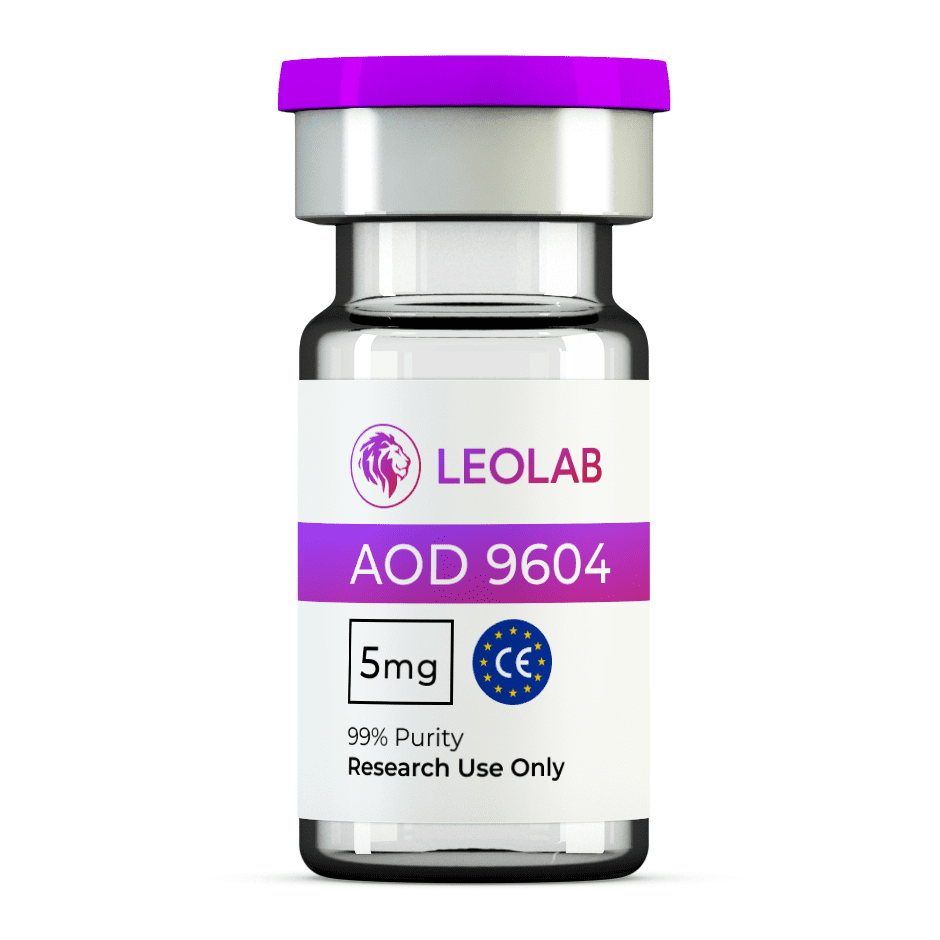
AOD 9604 – C-Terminal Growth Hormone Fragment for Lipid Metabolism Research
AOD 9604 is a synthetic peptide of 16 residues with the sequence Tyr–Leu–Arg–Ile–Val–Gln–Cys–Arg–Ser–Val–Glu–Gly–Ser–Cys–Gly–Phe, containing an intramolecular disulfide bond. It corresponds to residues 177–191 of human growth hormone, the C-terminal region, with a tyrosine residue added at the N-terminus. It was prepared by solid-phase synthesis and purified by reverse-phase HPLC in the laboratory that described it.
The design rationale is domain separation. Full-length growth hormone has several biological activities mediated by different structural regions: the growth-promoting effects operate through growth hormone receptor binding domains in the N-terminal portion, while the lipolytic domain was localized to the C-terminal region. The fragment was synthesized to isolate the latter activity from the former.
In the principal preclinical report, both growth hormone and the fragment reduced body weight and body fat in obese (ob/ob) mice after 14 days of chronic intraperitoneal administration, and both raised the suppressed levels of β3-adrenergic receptor RNA in obese mice toward levels seen in lean animals. The β3-adrenergic receptor is the major lipolytic receptor in fat tissue. In β3-adrenergic receptor knockout mice, long-term treatment with either compound failed to produce the body weight change and increased lipolysis seen in wild-type controls; however, in an acute experiment the fragment still increased energy expenditure and fat oxidation in those knockout animals. The authors concluded that the lipolytic actions of both are not mediated directly through the β3-adrenergic receptor, although both increase its expression, which may subsequently contribute to lipolytic sensitivity.
Key Research Areas
Growth Hormone Domain Mapping: Used to separate the lipolytic region of the hormone from the receptor-binding and growth-promoting regions.
β3-Adrenergic Receptor Expression: Investigated in obese mouse adipose tissue, where receptor RNA levels are the measured endpoint.
Knockout Model Mechanism Studies: Applied in β3-adrenergic receptor knockout mice to test whether the lipolytic response requires that receptor, with chronic and acute protocols giving different answers.
Energy Expenditure and Fat Oxidation: Examined by indirect calorimetry in acute experiments alongside chronic weight and fat mass endpoints.
Adipocyte Lipolysis: Studied in fat cell preparations in connection with lipolytic sensitivity and lipogenic enzyme activity.
Peptide Fragment Design: Serves as a reference example of fragment-based separation of multiple activities within one hormone.
Product Details
- Name: AOD 9604
- Type: Research peptide
- Quantity: 5mg per vial
- Form: Lyophilized powder
- Molecular Formula: C₇₈H₁₂₃N₂₃O₂₃S₂
- Molecular Weight: 1815.10 g/mol
- Purity: ≥98% (HPLC verified)
- Storage: Store at 2–8°C, protected from light and moisture
- Use: For laboratory research use only. Not for human consumption.
Selected literature
- Heffernan M., Summers R.J., Thorburn A., et al. The effects of human GH and its lipolytic fragment (AOD9604) on lipid metabolism following chronic treatment in obese mice and β3-AR knock-out mice. Endocrinology, 2001;142(12):5182–5189. https://doi.org/10.1210/endo.142.12.8522
- de Vos A.M., Ultsch M., Kossiakoff A.A. Human growth hormone and extracellular domain of its receptor: crystal structure of the complex. Science, 1992;255(5042):306–312. https://doi.org/10.1126/science.1549776