Description
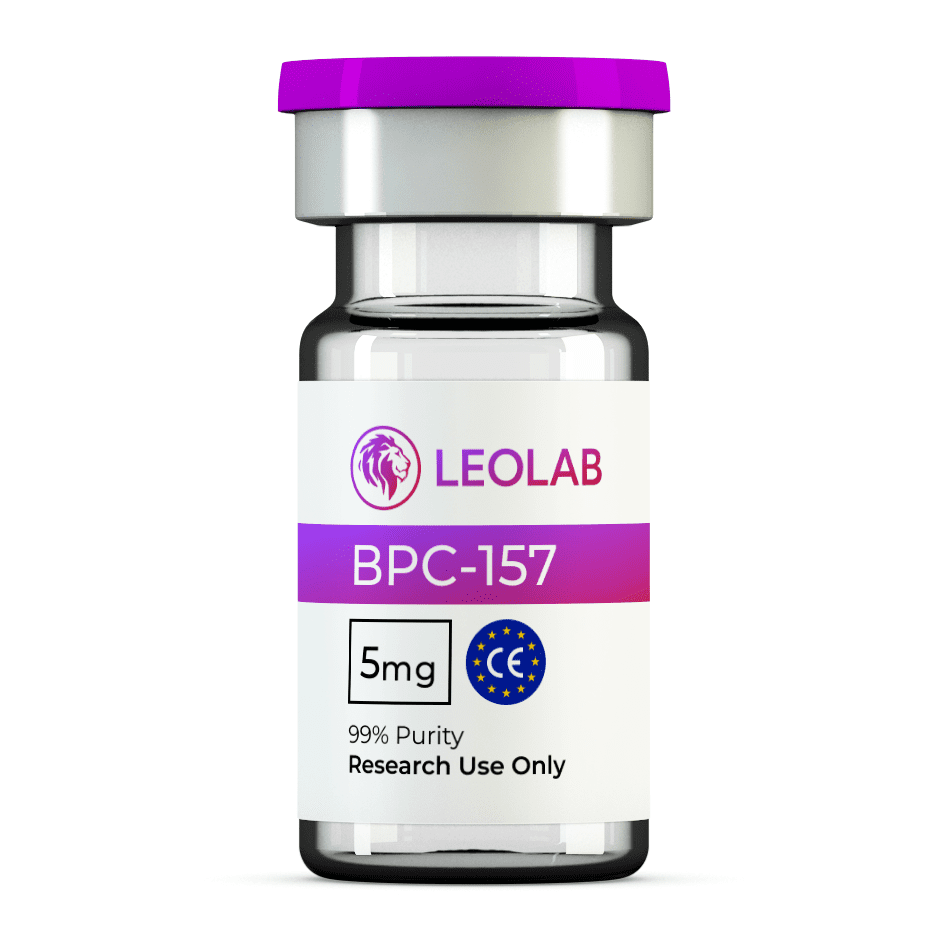
BPC-157 – Gastric Pentadecapeptide for Tissue Repair Research
BPC-157 is a synthetic peptide of 15 residues with the sequence Gly–Glu–Pro–Pro–Pro–Gly–Lys–Pro–Ala–Asp–Asp–Ala–Gly–Leu–Val (GEPPPGKPADDAGLV). It corresponds to a partial sequence of body protection compound (BPC), a protein originally isolated from human gastric juice. In the published literature it is described as stable in human gastric juice for periods longer than 24 hours, a property that distinguishes it from growth factor peptides which are rapidly degraded there and which require a carrier in experimental use.
The peptide has been studied most extensively in rat injury models by a single research group in Zagreb and by several independent laboratories. Reported endpoints include transected Achilles tendon, transected quadriceps muscle, ligament injury and gastrointestinal lesions. In the Achilles tendon work, treated animals were assessed biomechanically by load at failure and Young’s modulus, functionally by the Achilles functional index, and histologically by fibroblast, reticulin and collagen formation. Separate in vitro work examined the peptide in cultured tendon fibroblasts.
Mechanistic characterization remains incomplete. Published cell work has examined tendon explant outgrowth, cell survival and migration with attention to focal adhesion kinase and paxillin phosphorylation, and a separate study reported upregulation of the growth hormone receptor in tendon fibroblasts as a candidate contributing pathway. All findings described here derive from cell culture and animal studies.
Key Research Areas
Tendon Injury Models: Used in rat Achilles tendon transection studies with biomechanical, functional, macroscopic and histological endpoints.
Ligament and Muscle Healing: Investigated in rat models of ligament injury and transected quadriceps muscle, with assessment across extended post-injury periods.
Fibroblast Outgrowth and Migration: Examined in cultured tendon explants and fibroblasts, where effects on outgrowth and migration were studied alongside focal adhesion kinase and paxillin signaling.
Growth Hormone Receptor Expression: Studied in rat tendon fibroblasts, where increased receptor expression was proposed as a mechanism potentiating the proliferative response to growth hormone.
Gastrointestinal Models: Investigated in rat models of gastric and duodenal lesions, reflecting the peptide’s origin as a fragment of a gastric juice protein.
Peptide Stability: Used as a reference example of a peptide reported to resist degradation in gastric juice without a carrier system.
Product Details
- Name: BPC-157
- Type: Research peptide
- Available strengths: 5mg, 10mg
- Form: Lyophilized powder
- Molecular Formula: C₆₂H₉₈N₁₆O₂₂
- Molecular Weight: 1419.56 g/mol
- Purity: ≥98% (HPLC verified)
- Storage: Store at 2–8°C, protected from light and moisture
- Use: For laboratory research use only. Not for human consumption.
Selected literature
- Staresinic M., Sebecic B., Patrlj L., et al. Gastric pentadecapeptide BPC 157 accelerates healing of transected rat Achilles tendon and in vitro stimulates tendocytes growth. Journal of Orthopaedic Research, 2003;21(6):976–983. https://doi.org/10.1016/S0736-0266(03)00110-4
- Staresinic M., Petrovic I., Novinscak T., et al. Effective therapy of transected quadriceps muscle in rat: gastric pentadecapeptide BPC 157. Journal of Orthopaedic Research, 2006;24(5):1109–1117. https://doi.org/10.1002/jor.20089
- Cerovecki T., Bojanic I., Brcic L., et al. Pentadecapeptide BPC 157 (PL 14736) improves ligament healing in the rat. Journal of Orthopaedic Research, 2010;28(9):1155–1161. https://doi.org/10.1002/jor.21107
- Chang C.H., Tsai W.C., Lin M.S., Hsu Y.H., Pang J.H.S. The promoting effect of pentadecapeptide BPC 157 on tendon healing involves tendon outgrowth, cell survival, and cell migration. Journal of Applied Physiology, 2011;110(3):774–780. https://doi.org/10.1152/japplphysiol.00945.2010
- Chang C.H., Tsai W.C., Hsu Y.H., Pang J.H.S. Pentadecapeptide BPC 157 enhances the growth hormone receptor expression in tendon fibroblasts. Molecules, 2014;19(11):19066–19077. https://doi.org/10.3390/molecules191119066