Description
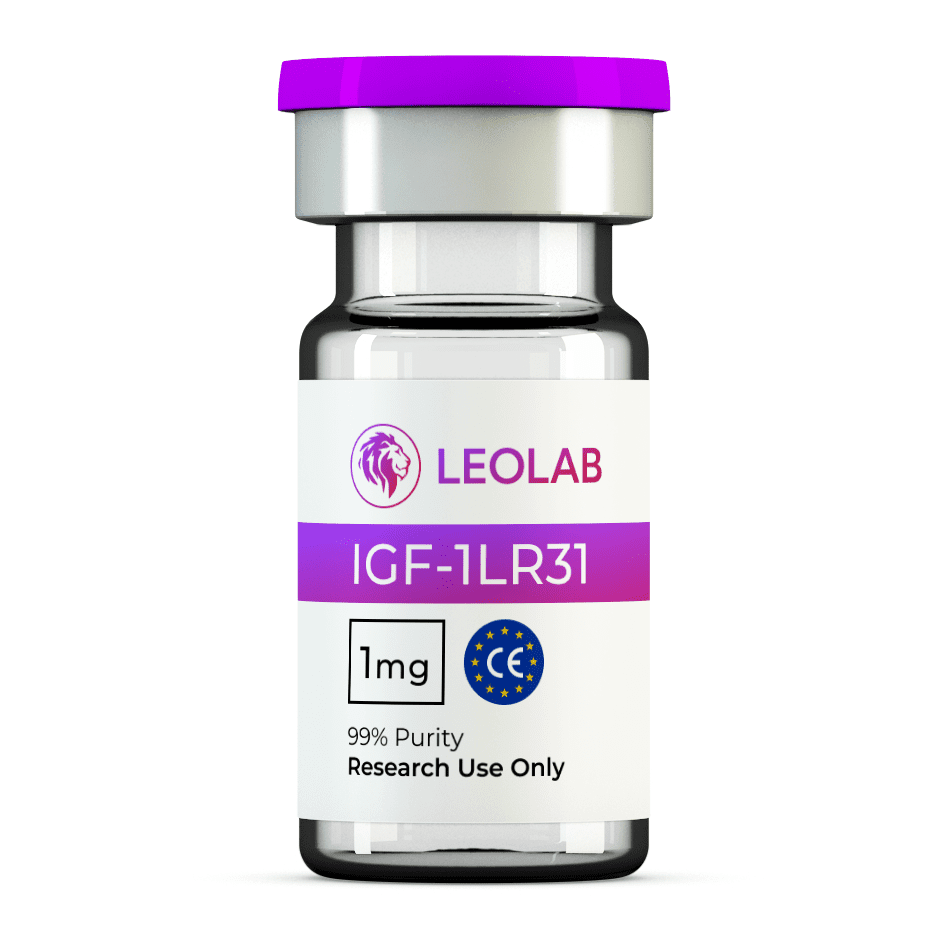
IGF-1 LR3 – Long R3 Insulin-Like Growth Factor 1 Analog
IGF-1 LR3 is a modified recombinant analog of insulin-like growth factor 1, a 70-residue polypeptide. Two changes are made to the native sequence. A 13-residue extension is added at the amino terminus, giving a protein of 83 residues, and the glutamate at position 3 is replaced by arginine, which is the substitution the designation R3 refers to.
The purpose of both modifications is the same: to reduce affinity for the insulin-like growth factor binding proteins. In circulation and in culture medium, native IGF-1 is largely sequestered by a family of six binding proteins that regulate its availability to the receptor. For cell culture work this is a practical obstacle, since binding proteins secreted by the cells themselves alter the effective concentration of added growth factor in ways that are difficult to control. An analog with reduced binding protein affinity remains available to the IGF-1 receptor, which makes dose-response relationships more interpretable. This is why the modified form, rather than native IGF-1, is the common reagent in cell culture supplementation.
The original characterization work bears this out directly. Analogs with glycine or arginine substituted for glutamate at position 3 were produced by expression in Escherichia coli as fusion proteins, and both were more potent than native IGF-1 in assays measuring stimulation of protein synthesis and DNA synthesis and inhibition of protein breakdown in rat L6 myoblasts. Both analogs bound very poorly to IGF-binding protein-2 and, notably, slightly less well than native IGF-1 to the type 1 receptor. The authors concluded that reduced binding protein affinity, rather than increased receptor binding, explains the greater biological potency.
Solution structure work by nuclear magnetic resonance on the Long-[Arg3] form later interpreted its lower binding protein affinity in structural terms, and reported a considerable degree of backbone flexibility, including within the helices.
Key Research Areas
IGF-1 Receptor Signaling: Used as a receptor agonist in cell culture studies of downstream kinase cascades.
Binding Protein Interference: Applied specifically in systems where secreted binding proteins would otherwise confound dose-response measurement.
Cell Culture Supplementation: Employed as a defined growth factor component in serum-free and reduced-serum media.
Comparative Analog Studies: Examined alongside native IGF-1 to separate receptor-mediated effects from binding protein-mediated availability.
Protein Engineering: Illustrates N-terminal extension and point substitution used together to modify a protein’s interaction partners without altering its receptor activity.
Product Details
- Name: IGF-1 LR3
- Type: Recombinant protein
- Quantity: 1mg per vial
- Form: Lyophilized powder
- Purity: ≥98% (HPLC verified)
- Storage: Store at 2–8°C, protected from light and moisture
- Use: For laboratory research use only. Not for human consumption.
No molecular formula or molecular weight is stated: published figures for this analog differ from one another, and no source was found that could be verified against the stated 83-residue composition.
Selected literature
- Francis G.L., Ross M., Ballard F.J., et al. Novel recombinant fusion protein analogues of insulin-like growth factor (IGF)-I indicate the relative importance of IGF-binding protein and receptor binding for enhanced biological potency. Journal of Molecular Endocrinology, 1992;8(3):213–223. https://pubmed.ncbi.nlm.nih.gov/1377842/
- King R., Wells J.R.E., Krieg P., et al. Production and characterization of recombinant insulin-like growth factor-I (IGF-I) and potent analogues of IGF-I, with Gly or Arg substituted for Glu3, following their expression in Escherichia coli as fusion proteins. Journal of Molecular Endocrinology, 1992;8(1):29–41. https://doi.org/10.1677/jme.0.0080029
- Laajoki L.G., Francis G.L., Wallace J.C., Carver J.A., Keniry M.A. Solution structure and backbone dynamics of long-[Arg3]insulin-like growth factor-I. Journal of Biological Chemistry, 2000;275(14):10009–10015. https://doi.org/10.1074/jbc.275.14.10009